According to the Bank of Korea’s release Balance of Payments for August 2026 (preliminary) (in Korean), published on 8 October 2026, Korea’s goods balance showed a surplus of $46.81 billion in August. Yet the customs figures printed in a reference table at the back of the same release give a different answer: exports of $98.28 billion minus imports of $63.50 billion is a trade surplus of $34.78 billion. Same month, same country, same trade in goods, and the two surpluses differ by $12.03 billion.
Neither figure is wrong. The two statistics differ in what they count, when, and at what value. By the end of this note you will be able to tell which question each figure answers when the news reports a trade balance and a goods balance separately, and you will be able to follow where the gap comes from with a small calculation.
One August, two surpluses
Start by putting the numbers side by side. On the customs basis of the Korea Customs Service, August exports were $98.28 billion and imports $63.50 billion. On the Bank of Korea’s balance of payments (BOP) basis, exports were $104.80 billion and imports $57.99 billion. The BOP figures show exports $6.52 billion higher and imports $5.51 billion lower. Together, 6.52 + 5.51 = $12.03 billion, the gap between the two surpluses.
ECONOMY NOTES
One August, two surpluses
August 2026, billions of US dollars
Customs trade balance (Korea Customs Service)
- Exports 98.28 − imports (CIF) 63.50
- = 34.78 surplus
BOP goods balance (Bank of Korea)
- Exports 104.80 − imports (FOB) 57.99
- = 46.81 surplus
The 12.03 gap comes from both sides
- Exports 6.52 higher (104.80 − 98.28)
- Imports 5.51 lower (63.50 − 57.99)
- 6.52 + 5.51 = 12.03
The current account adds three more lines
- Goods 46.81 + services −1.68
- + primary income 1.92 + secondary income −0.94
- = 46.11
Source: Bank of Korea, Balance of Payments for August 2026 (preliminary), 8 October 2026: main table and Reference 1, customs-basis trade (data: Korea Customs Service). Preliminary figures may be revised.
The goods balance is the first line of the current account. August’s current account surplus of $46.11 billion is the goods balance of $46.81 billion plus services of −$1.68 billion, primary income of $1.92 billion and secondary income of −$0.94 billion. So the goods figure in a “current account surplus” headline is the BOP goods balance, not the customs trade balance. The Bank of Korea’s own note under the release table says that BOP goods trade differs from customs-basis trade, which covers goods declared at customs in Korea.
Not just an August thing
The same release also allows a comparison with August last year and July this year. In August 2025 the customs trade balance was $6.40 billion and the goods balance $10.72 billion; in July 2026, $30.65 billion and $40.43 billion. In all three months the goods balance was larger. For January to August 2026, the customs trade balance was 693.59 − 490.96 = $202.63 billion, while the goods balance was $281.09 billion.
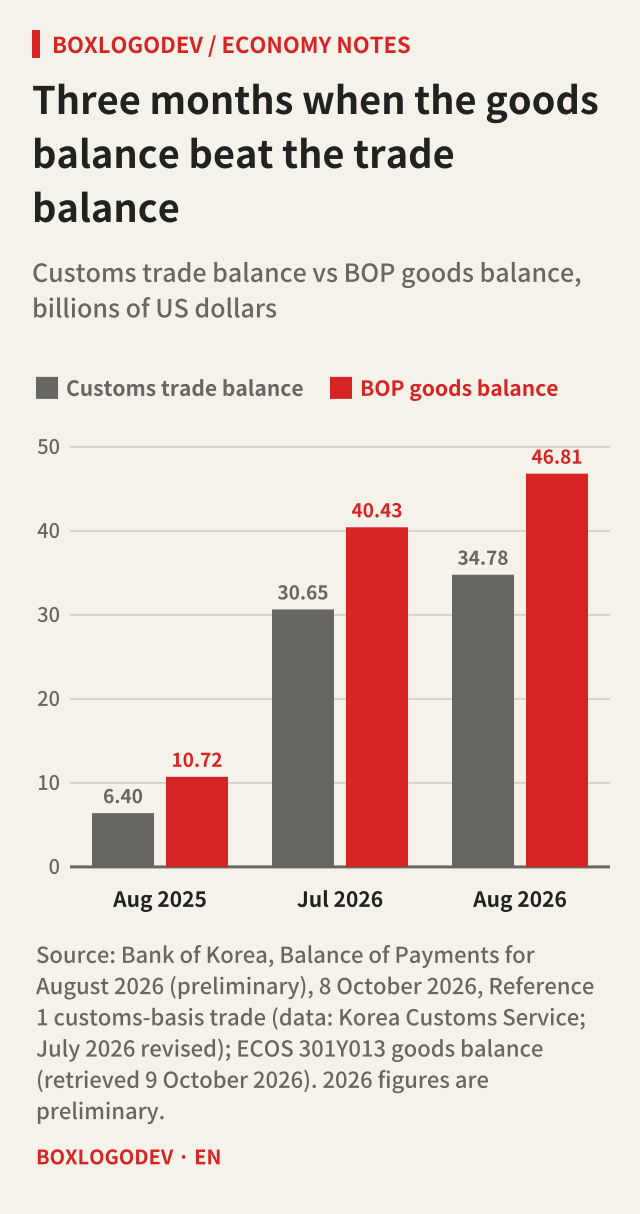
It would be a mistake, though, to turn this into a rule that the goods balance always exceeds the trade balance. The size and even the direction of the gap depend on the mix of trade and on how companies organise production, and this note has only checked the periods in this release. The 2026 figures are also preliminary and are revised when the source data change, which is why July’s customs figure is marked as revised.
What is counted, when, and at what value
The first difference is what counts as trade. Customs statistics count goods when they cross Korea’s customs border. The balance of payments, following the IMF’s Balance of Payments Manual (BPM6), counts goods when ownership passes from a resident to a nonresident or the other way round. The Bank of Korea’s glossary of 800 economic and financial terms names this change-of-ownership rule as the main reason the two figures differ.
That one rule changes a lot. If a Korean company sends parts to a plant abroad only to have them assembled, and keeps ownership, the parts crossed the border and appear in customs exports, but nothing was sold, so they are left out of BOP exports. Conversely, when the finished products made at that plant are sold by the Korean company to a foreign buyer, they count as BOP exports even though they never touched Korean soil. The assembly fee paid to the plant abroad is recorded not as goods but as manufacturing services in the services account. In August that item showed a deficit of $0.65 billion, meaning processing fees paid abroad exceeded those received from abroad by that amount.
ECONOMY NOTES
Three things the two statistics count differently
Customs basis (Korea Customs Service) vs BOP basis (Bank of Korea)
1 · What counts as trade
- Customs: goods crossing the customs border
- BOP: ownership passing between residents and nonresidents
- Goods sent for processing without a sale are left out
2 · Trade that never crosses Korea’s border
- Merchanting: bought abroad, sold abroad
- Customs: zero. BOP: recorded as net exports
- August net merchanting exports: $1.35 billion
3 · Where imports are valued
- Customs imports: CIF (freight and insurance included)
- BOP imports: FOB (value at the port of shipment)
- Freight and insurance are handled as services
Plus timing, classification and coverage adjustments
- The release does not split the gap by cause
Sources: Bank of Korea, Balance of Payments for August 2026 (preliminary), notes and statistical overview; Bank of Korea glossary entry for the goods balance; ECOS 301Y013 net merchanting exports (retrieved 9 October 2026); IMF BPM6 Compilation Guide, chapter 11.
The second difference is trade that never crosses the border at all. Merchanting means buying goods abroad and selling them on to another country without bringing them into Korea. It does not appear in customs statistics, but in the balance of payments the margin, sales minus purchases, enters the goods balance as “net exports of goods under merchanting.” The Bank of Korea’s statistics system (ECOS) puts August net merchanting exports at $1.35 billion. That much of the $6.52 billion gap on the export side has a name.
The third difference is valuation. Customs statistics value exports FOB, at the port of shipment, and imports CIF, including freight and insurance. The balance of payments values both exports and imports FOB. Freight and insurance therefore have to be taken out of customs imports to reach BOP imports, which makes imports smaller and the surplus larger. The freight and insurance do not vanish; they are recorded separately as services.
The release adds that customs data are also adjusted for timing, classification and coverage to match the BOP basis. It does not, however, publish a table splitting August’s $12.03 billion gap by cause. So apart from the $1.35 billion of merchanting, this note does not assign amounts to individual causes.
A hypothetical surplus of 30 that becomes 43.5
A small hypothetical example shows how the three rules combine. The numbers are chosen for illustration; they are not a real company or August’s actual flows, and they have no unit.
ECONOMY NOTES
How a surplus of 30 becomes 43.5
Hypothetical example · not a real company or August’s actual flows
Customs basis
- Exports 100 (incl. 15 of parts sent abroad for processing)
- Imports CIF 70 (incl. 3.5 of freight and insurance)
- Trade balance 100 − 70 = 30
Recount exports
- Remove the 15 of parts (ownership unchanged)
- Add 20 of finished goods sold from the plant abroad
- 100 − 15 + 20 = 105
Merchanting, FOB imports
- Bought abroad for 40, sold abroad for 45: net exports +5
- Imports 70 − freight and insurance 3.5 = 66.5
Goods balance
- 105 + 5 − 66.5 = 43.5
- Gap 13.5 = −15 + 20 + 5 + 3.5
Hypothetical values for illustration, with no unit. The processing fee paid to the plant abroad and the freight on imports go to the services account, not the goods balance.
On the customs basis, exports are 100 and imports 70, so the trade balance is 30. The 100 of exports includes 15 of parts sent to a contract plant abroad for assembly, and the 70 of imports includes 3.5 of freight and insurance. Now count again on the BOP basis. Remove the 15 of parts whose ownership did not change and add the 20 of finished goods made at that plant and sold abroad: exports become 100 − 15 + 20 = 105. Merchanting, buying for 40 abroad and selling for 45 to another country, adds net exports of 5. Imports are 70 minus 3.5 of freight and insurance, or 66.5.
The goods balance is then 105 + 5 − 66.5 = 43.5. The gap of 13.5 from the customs trade balance of 30 splits exactly into −15 + 20 + 5 + 3.5. The numbers were chosen so that no rounding is needed, so you can check them on a calculator. The assembly fee and the import freight are not in this calculation, but the balance of payments records them in the services account, so they still end up in the current account.
One thing to check in the news
The trade balance and the goods balance answer different questions. The customs trade balance counts goods that crossed Korea’s border; the BOP goods balance counts goods bought and sold between residents and nonresidents. The goods balance is also part of the current account, which covers all of a country’s current transactions with the rest of the world. Next time the two figures are reported differently, check first whether the source is customs statistics or the Bank of Korea’s balance of payments. That single step clears up most of the confusion about why the surpluses differ.
Add your perspective.
Share a question, another approach, or something you have tried.
Checking sign-in…
Loading comments…