According to the Bank of Korea’s release Official Foreign Reserves as of the End of September 2026 (in Korean), published on 6 October 2026, Korea’s foreign exchange reserves stood at $440.56 billion at the end of September, $1.72 billion less than the $442.28 billion recorded at the end of August. It was the first decline in four months. It is tempting to read the figure as “the central bank sold $1.72 billion to prop up the won.”
This note checks, with numbers, why that reading does not hold. By the end you will be able to separate the different pieces mixed into a change in reserves, and you will know where and when the actual amount of dollars sold in the market is published.
Reserves are a balance measured in dollars
Foreign exchange reserves are external assets that the central bank and government hold so they can be used at short notice. The Bank of Korea’s glossary of 800 economic and financial terms compares them to an emergency fund. They pay for calming the market when the exchange rate jumps, and they are the last resort when financial institutions cannot borrow abroad.
The $440.56 billion at the end of September consisted of securities ($386.03 billion, 87.6%), deposits ($29.95 billion, 6.8%), SDRs ($15.48 billion, 3.5%), gold ($4.79 billion, 1.1%) and the IMF reserve position ($4.30 billion, 1.0%). Most of it is foreign currency bonds such as advanced-economy government debt, plus bank deposits.
The key point is that the figure is not a sum of the month’s purchases and sales. It is the month-end value of everything held, converted into US dollars. A month’s change therefore mixes dollar sales and purchases with interest income, money that others deposit or withdraw, and changes in the dollar value of assets as exchange rates move.
ECONOMY NOTES
September’s −$1.72 billion, item by item
End of August → end of September 2026, billions of US dollars
Total
- 442.28 → 440.56
- Change: −1.72
Change by item (published, rounded)
- Securities −1.05 · deposits −0.35
- SDRs −0.29 · IMF position −0.04
- Gold 0.00
The items sum to −1.73, the total is −1.72
- −1.05 − 0.35 − 0.29 + 0.00 − 0.04 = −1.73
- Each item was rounded separately
- Exact total fall: $1,724,657 thousand
- → rounds to $1.72 billion
Gold did not change by a single digit
- August and September: $4,794,932 thousand
Source: Bank of Korea, Official Foreign Reserves as of the End of September 2026 (6 October 2026); ECOS 732Y001 (retrieved 7 October 2026).
Even the item table has a small trap. In billions of dollars, the month-on-month changes in the release add up to −1.05 − 0.35 − 0.29 + 0.00 − 0.04 = −1.73, but the total is −1.72. The release states amounts in units of 100 million dollars, rounded to one decimal place, and each item was rounded on its own. Recalculated from the thousand-dollar values in the Bank of Korea’s statistics system (ECOS), the total fell by $1,724.66 million, which rounds to $1.72 billion. A note under the release table says the items may not add up because of rounding.
The reasons the Bank of Korea gave for September
The release names three reasons. Despite investment income, first, foreign currency deposits placed by financial institutions fell; second, assets were entrusted to the Korea-US Strategic Investment Corporation; and third, the dollar value of assets held in other currencies fell. Selling dollars in the market is not on the list.
The three are different in kind. Foreign currency deposits are foreign currency that financial institutions keep at the Bank of Korea, so reserves rise when they grow and fall when the money leaves. When reserves rose by $14.33 billion in August, the first reason the bank gave was a large increase in these deposits; in September they fell instead. The assets entrusted to the Korea-US Strategic Investment Corporation dropped out of the reserve count. The bank added that further amounts and timing for such entrustment have not been decided.
The third reason is the heart of this note. Besides US dollars, the Bank of Korea holds assets in euros, yen, pounds, Australian dollars, Canadian dollars and Chinese yuan. At the end of 2025 the US dollar accounted for 69.5% of its foreign currency holdings. When the dollar strengthens against other currencies, a euro bond is worth fewer dollars even if not a single one is sold. SDRs are the IMF’s unit of account, valued against a basket of five currencies (US dollar, euro, pound, yen and yuan), so they are affected in the same way. Part of the $0.29 billion fall in SDRs in September may reflect this conversion effect, though the release does not give reasons item by item.
ECONOMY NOTES
The same reasons push both ways
Reasons given by the Bank of Korea for each monthly change, June–September 2026
June: +$0.37 billion
- Despite stabilisation measures such as
- the NPS FX swap, bank FX deposits rose
July: +$0.59 billion
- Despite the NPS FX swap and others:
- new FX stabilisation bonds, income, higher conversion
August: +$14.33 billion
- Bank FX deposits rose sharply
- Investment income, higher conversion
September: −$1.72 billion
- Despite income, bank FX deposits fell
- Entrustment to KUSIC, lower conversion
Source: Bank of Korea reserve releases for end-June, July, August and September 2026 (3 July, 5 August, 3 September, 6 October 2026). ‘Conversion’ is the US dollar value of assets in other currencies. KUSIC: Korea-US Strategic Investment Corporation.
Read four months together and a pattern appears. In June, reserves rose by $0.37 billion because deposits increased, despite market stabilisation measures such as the foreign exchange swap with the National Pension Service. In July they rose by $0.59 billion thanks to a new foreign currency stabilisation bond issue, investment income and higher conversion values. Stabilisation measures push reserves down, but when the other pieces are larger, the balance still goes up.
Actual net dollar sales are published separately each quarter
How much the foreign exchange authorities (the government and the Bank of Korea) actually bought or sold in the market is not in the reserves release. It is published quarterly as net transactions of the foreign exchange authorities (in Korean), three months after the quarter ends. The figure for the second quarter of 2026, released on 30 September 2026, was −$9.612 billion: net sales of more than $9.6 billion.
Put these figures next to the change in reserves for the same quarter and the difference is clear. Quarter-end reserves are the month-end values from ECOS.
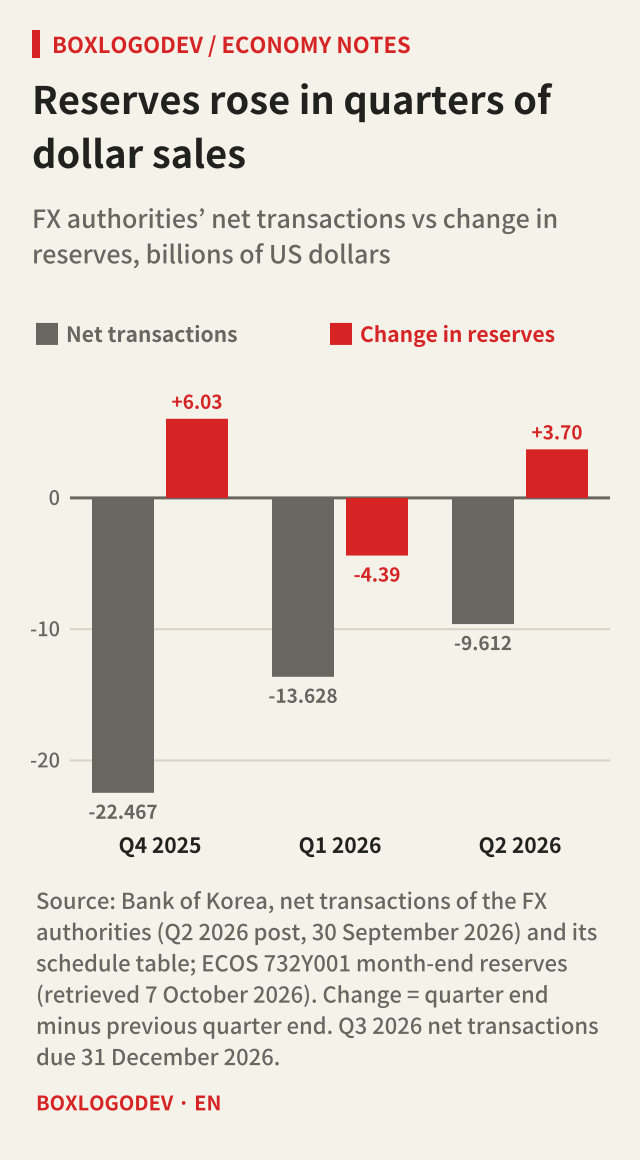
In the fourth quarter of 2025 the authorities sold a net $22.467 billion, yet reserves rose by $6.03 billion, from $422.02 billion to $428.05 billion. In the first quarter of 2026 net sales of $13.628 billion came with a $4.39 billion fall in reserves, and in the second quarter net sales of $9.612 billion came with a $3.70 billion rise. The quarter with the largest net sales saw the largest rise in reserves, so guessing intervention from the change in reserves can get even the direction wrong.
When will the third quarter, which includes September, be known? According to the published schedule, on 31 December 2026. Until then, there is no basis for calling September’s −$1.72 billion “dollars sold.”
A hypothetical fall of $1.7 billion without a single sale
A small hypothetical example shows how large the conversion effect can be. The numbers below are chosen for illustration; they are not the Bank of Korea’s actual currency mix or its actual September flows.
ECONOMY NOTES
$1.7 billion gone without selling a dollar
Hypothetical example · not the actual currency mix or September flows
Start: reserves of $400 billion
- Dollar assets 280 (70%)
- Euro, yen and other assets 120 (30%)
Other currencies fall 1% against the dollar
- 120 × 0.99 = 118.8 → −1.2
- Dollar value −$1.2 billion, nothing sold
Deposit withdrawal, investment income
- Banks withdraw $1.0 billion of deposits: −1.0
- Bond interest and other income: +0.5
Total
- −1.2 − 1.0 + 0.5 = −1.7
- Market dollar sales: 0. Balance: −$1.7 billion
Hypothetical figures in billions of US dollars. The US dollar share of the Bank of Korea’s foreign currency holdings was 69.5% at the end of 2025 (Bank of Korea, reserve management).
Suppose reserves are $400 billion and 30% of them, $120 billion, are in non-dollar assets such as euros and yen. If those currencies weaken by 1% on average against the dollar in a month, 120 × 0.99 = 118.8, so $1.2 billion disappears without anything being sold. If financial institutions withdraw $1.0 billion of their deposits in the same month, reserves fall by another $1.0 billion, and $0.5 billion of investment income such as bond interest adds that much back. −1.2 − 1.0 + 0.5 = −$1.7 billion. A fall about the size of September’s, with zero dollar sales.
It works the other way too. In a month when the dollar weakens, conversion values rise, and reserves can look higher even after dollars were sold in the market. In the fourth quarter of 2025 and the second quarter of 2026, reserves did rise in quarters of net dollar sales. Whether the gap came from conversion values, deposits or investment income cannot be told from the quarterly figures alone.
Why gold has stayed at $4.79 billion for years
The gold line in the table also stands out. It reads $4.79 billion at the end of 2022, 2023, 2024 and 2025, and again at the end of August and September 2026. In ECOS’s thousand-dollar figures, August and September are both 4,794,932, identical to the last digit. In an April 2024 blog post the Bank of Korea said it had not bought gold since 2013, and its year-end gold figure has stayed near $4.79 billion since the end of 2013. International gold prices swung widely over the same period, so this item is evidently not revalued at market prices each month. That is why a rise in the gold price barely shows up in reserve changes.
What to check at the next release
When the next reserves figure comes out, look at three things in order. First, in the release’s opening paragraph, find which reasons are not transactions: foreign currency deposits, conversion values, investment income, bond issuance. Next, check whether the dollar strengthened or weakened against other major currencies that month. Finally, confirm the amount actually sold in the market from the authorities’ net transactions, published three months later. A change in reserves answers “what is the month-end balance worth in dollars,” not “how much was sold.”
Add your perspective.
Share a question, another approach, or something you have tried.
Checking sign-in…
Loading comments…