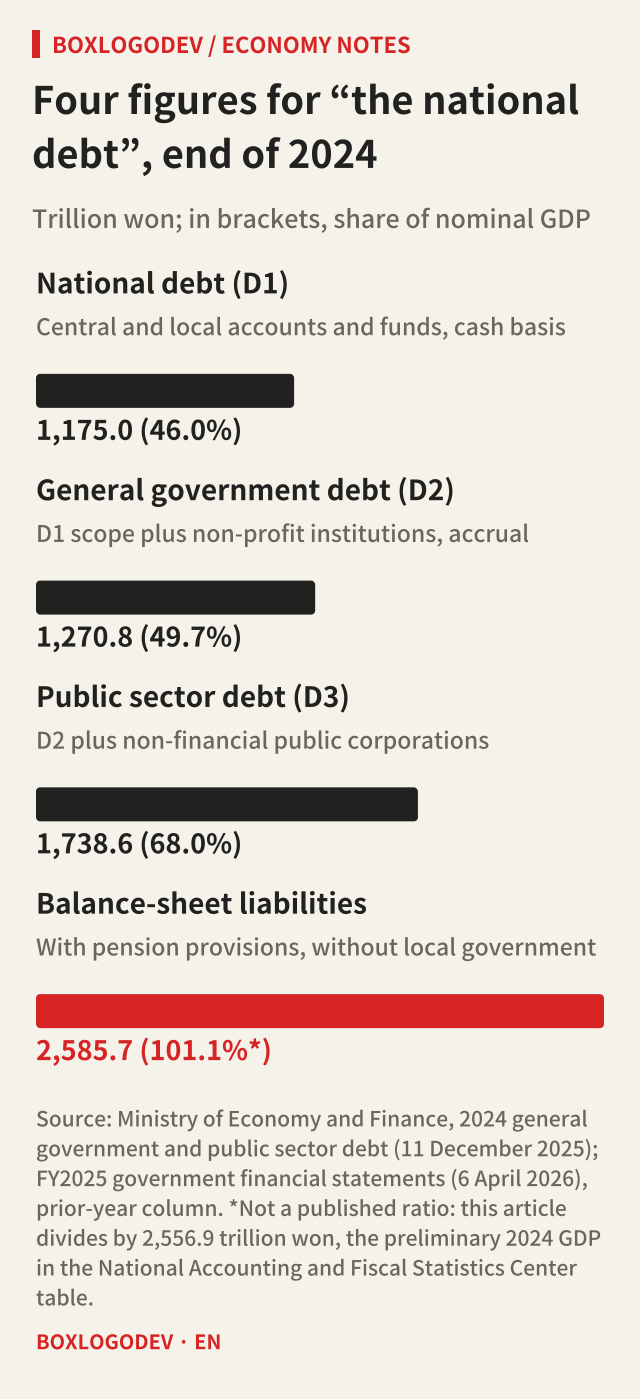
Ask how much Korea's government owed at the end of 2024 and official sources give four figures: national debt (D1) of 1,175.0 trillion won, general government debt (D2) of 1,270.8 trillion, public sector debt (D3) of 1,738.6 trillion, and liabilities of 2,585.7 trillion on the balance sheet in the government's annual financial statements. The smallest and largest are 1,410.7 trillion apart. None of them is wrong. They differ in what they cover and how they count. By the end of this note you can tell which of the four a news report is using, and work through the step from D1 to D2 and D3 using only the published tables.
The year is 2024 because, when checked on 1 November 2026, it was the latest year with all four figures out. Whether any of these amounts is too large is outside the scope here.
What each ruler measures
National debt (D1) counts what central and local government accounts and funds owe, on a cash basis. It is government bonds, borrowings and treasury obligations plus net local government debt, and the government mainly uses it to set debt-management targets and check results when it draws up budgets and settles accounts. Guarantees, the potential burden of public pensions, public corporations' debt and the Bank of Korea's monetary stabilization bonds are left out.
General government debt (D2) follows the compilation guide written jointly by the IMF, the OECD and others, on an accrual basis. It adds 357 non-profit public institutions to the accounts and funds. The Ministry of Economy and Finance release of 11 December 2025 (in Korean) says the IMF mainly uses this measure when comparing government debt across countries.
Public sector debt (D3) adds 159 non-financial public corporations to D2. Financial public corporations stay out. According to the same release only 8 OECD members produce this statistic, and Open Fiscal Data (in Korean) says that limits it as a comparison measure.
Balance-sheet liabilities are what the statement of financial position shows in the government's annual financial statements, prepared under the National Accounting Act. They are on an accrual basis and include liabilities whose timing and amount are not yet settled. The scope also differs from the other three: local government debt is out and funds run by public institutions are in.
Work it out: why adding to D1 does not give D2
The official table shortens D2 to “D1 + non-profit public institutions”. That line describes scope, and adding the amounts does not reach the total. All inputs are published figures in trillion won. Non-profit institutions come to 66.5 (central 62.0 plus local 4.5), so 1,175.0 + 66.5 = 1,241.5, which is 29.3 short of the published D2 of 1,270.8.
D2 starts not from D1 but from accounts and funds measured again on an accrual basis. Central 1,182.9 plus local 70.9 is 1,253.8, which is 78.8 above D1. Add the non-profit institutions, 66.5, and remove 49.4 (the sum of 25.1, 0.8 and 23.5) owed within general government, and you get 1,270.9. The 0.1 gap to the published figure is the rounding the table's note warns about.
Where does the 78.8 come from? It first splits by level of government. Central accounts and funds of 1,182.9 are 41.7 above D1's central debt of 1,141.2, and local accounts and funds of 70.9 are 37.0 above net local debt of 33.9 (together 78.7; the 0.1 is rounding). On the central side, the table on page 4 of the December 2025 attachment shows items that appear not to be in D1, such as housing subscription savings of 97.5 and other payables of 58.4, and it takes out 138.3 of government and public bonds held by pension funds and others. Subtracting the tables' lines gives 41.7: government bonds 1,127.5 − 1,139.8 = −12.3; public bonds, a line the D1 table does not have, +24.4; bonds held by pension funds and others −138.3; borrowings of 110.9 less D1's borrowings of 1.2 and treasury obligations of 0.2, +109.5; and other payables, also not in the D1 table, +58.4. The published tables do not link D1 items to D2 items one by one, however, so it could not be confirmed that lines with the same name hold the same items.
D3 works the same way. 1,270.8 + 567.5 − 99.6 = 1,738.7, against a published 1,738.6. Because 99.6 of transactions inside the public sector comes off after adding 567.5 of corporate debt, the gap between D3 and D2 is 467.8, not 567.5.
ECONOMY NOTES
The arithmetic from D1 to D2 and D3
End of 2024, in trillion won. The shorthand addition alone does not reach the total
Simple addition
1,175.0 + 66.5 = 1,241.5- D1 + non-profit public institutions (62.0 + 4.5)
- 29.3 short of the published D2 of 1,270.8
D2 as the table builds it
1,253.8 + 66.5 − 49.4 = 1,270.9- Accounts and funds 1,182.9 + 70.9 = 1,253.8 (accrual)
- Internal items −25.1 −0.8 −23.5 = −49.4
- Published 1,270.8; the 0.1 is table rounding
D3
1,270.8 + 567.5 − 99.6 = 1,738.7- Add non-financial public corporations, 567.5; remove 99.6 owed inside the public sector
- Published 1,738.6; again 0.1 of rounding
Source: Ministry of Economy and Finance, 2024 general government and public sector debt (11 December 2025), pp. 3 and 7. Step 1 and the 29.3 are this article's calculation. Financial public corporations are in none of these three.
Why 2,585.7 trillion won is larger even than D3
The balance-sheet total of 2,585.7 splits into confirmed liabilities of 1,015.8 and unconfirmed liabilities of 1,569.9. The largest unconfirmed item is pension provisions of 1,312.9, or 50.8% of the total (1,312.9 ÷ 2,585.7). They are an estimate of pensions yet to be paid, recorded as a liability, and an Etoday report on the FY2025 accounts (in Korean) describes them as payable to civil servants and military personnel.
One number here needs care. 2,585.7 minus 1,312.9 is 1,272.8, close to D2. But this count leaves out local government and includes funds run by public institutions, so it does not rebuild D2. Confirmed liabilities of 1,015.8 are also smaller than D1's central debt of 1,141.2, because scope and the handling of internal holdings differ. The four rulers are not steps on one staircase.
ECONOMY NOTES
Inside the 2,585.7 trillion won on the balance sheet
End of 2024, in trillion won. The prior-year column of the April 2026 accounts release
Confirmed liabilities 1,015.8
- Government bonds, borrowings and so on
- Smaller than D1's central debt of 1,141.2
- Bonds held by pension funds and others are removed as internal
Unconfirmed liabilities 1,569.9
1,312.9 + 70.6 + 186.4 = 1,569.9- Pension provisions 1,312.9, or 50.8% of the total
- Other provisions (guarantees, insurance) 70.6
- Other (housing subscription savings and so on) 186.4
Close, but not the same number
2,585.7 − 1,312.9 = 1,272.8- Near D2's 1,270.8, yet a different count
- This scope leaves out local government and includes funds run by public institutions
Source: FY2025 government accounts release (6 April 2026), p. 5; Open Fiscal Data, overview of D1, D2 and D3. The 50.8% and 1,272.8 are this article's calculation.
In the questions and answers of the 6 April 2026 accounts release (in Korean), the government says pension provisions estimate payments spread over many years and that actual spending is met first from pension contributions, so they differ from debt that must be repaid now. That is the government's explanation. How any shortfall in contributions is covered remains a separate question.
Why did the ratio fall while the amount rose?
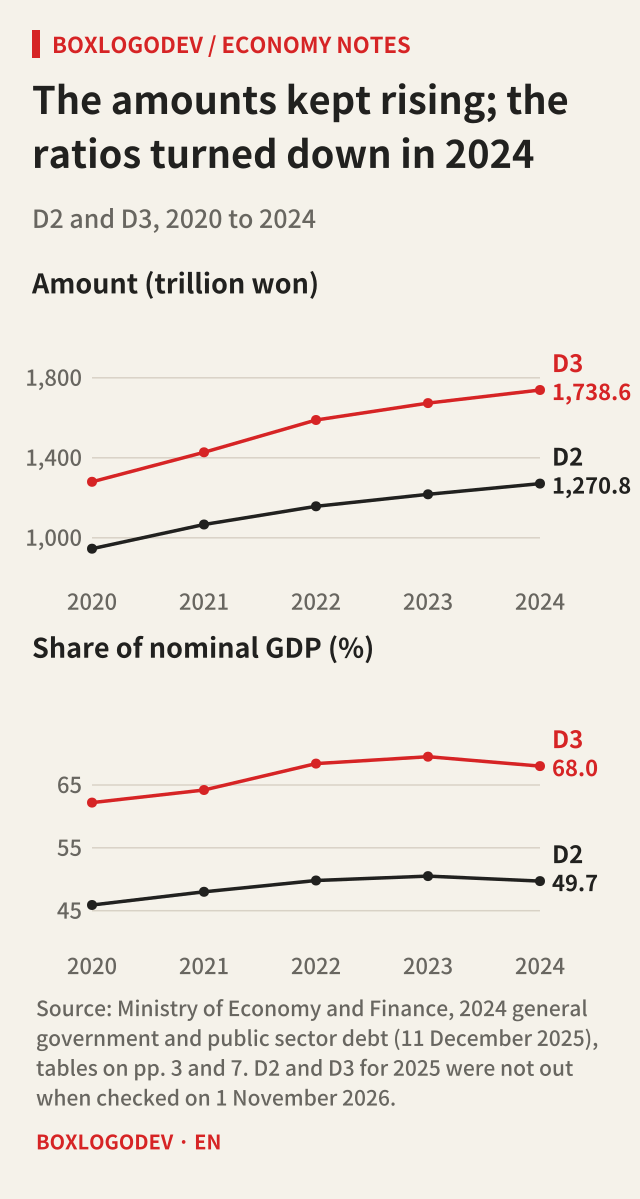
D2 rose 4.4%, from 1,217.3 trillion won in 2023 to 1,270.8 trillion in 2024. Nominal GDP, as listed in the National Accounting and Fiscal Statistics Center table (in Korean), rose 6.2%, from 2,408.7 trillion to 2,556.9 trillion (preliminary). The denominator grew faster, so the ratio fell 0.8 percentage points, from 50.5% to 49.7%. D3 likewise rose 3.9% in amount while its ratio fell 1.5 percentage points, from 69.5% to 68.0%. A lower ratio does not mean the debt shrank.
The ratio for the same debt can also differ between sources. For the 2024 D1 of 1,175.0 trillion won, the December 2025 release shows 46.0% of GDP, while e-Narajipyo (in Korean), updated on 14 September 2026, shows 45.8%. The 2026-2030 National Debt Management Plan lists 2024 nominal GDP as 2,564.2 trillion won, the same as Bank of Korea ECOS on 1 November 2026, and dividing by it gives 45.82%, so the GDP revision is what moved the ratio. Amounts can also change in later releases. The April 2025 accounts release gave D1 of 1,175.2 trillion and balance-sheet liabilities of 2,585.8 trillion; this note uses the later 1,175.0 and 2,585.7. When quoting a figure, it is safer to say which release it came from.
Which 2025 figures are out?
This is what could be confirmed on 1 November 2026. For fiscal 2025, the April accounts release gives D1 of 1,304.5 trillion won, 49.0% of GDP (preliminary), and balance-sheet liabilities of 2,771.6 trillion. e-Narajipyo now shows D1 on a settled-accounts basis of 1,305.2 trillion and 48.8%. Central government debt is unchanged at 1,268.1 trillion; net local debt moved from April's projection of 36.4 trillion to 37.1 trillion, which accounts for the 0.7 trillion difference.
D2 and D3 for 2025 were not out by that date. Last year's release came on 11 December, the government says it publishes the previous year's result at the end of each year, and Open Fiscal Data also says these come out around December each year, so 2024 is likely to be the latest year still when this note appears on 27 November. This year's date could not be found, so check notices from the Ministry of Finance and Economy and the Ministry of Planning and Budget.
When a report mentions “the national debt”, ask three things. How much of government is in it? Cash or accrual? Does the figure's purpose fit the claim being made? In a sentence comparing Korea with other countries, for example, this note's reading is that D2 at 49.7% is the right match, not D1 at 46.0%.
Add your perspective.
Share a question, another approach, or something you have tried.
Checking sign-in…
Loading comments…