The October issue of Monthly Public Finance, published by Korea's Ministry of Planning and Budget on 15 October 2026, shows a consolidated fiscal balance of 5.0 trillion won in surplus through August. The same sentence shows a managed fiscal balance of 43.0 trillion won in deficit. Which one is the government's real result? Both numbers are right, and they answer different questions.
After reading this you will be able to rebuild both figures from one table in the report. You will also be able to set the August total beside the same point last year, the full-year plan and last year's final accounts, and judge how much it can tell you.
Rebuild it from one table
All figures are in trillion won, cumulative for January to August 2026 and preliminary. The consolidated balance is total revenue minus total spending: 529.7 − 524.7 = 5.0. Total revenue is national taxes of 329.9, non-tax revenue of 32.0 and fund revenue of 167.8 added together. It is often called the nation's budget, but local taxes are not among the revenue items in the table on page 4.
The social security funds are inside those totals. Their revenue is 111.1 and their spending 63.0, so their balance is 111.1 − 63.0 = 48.1 in surplus. The managed balance is the consolidated balance minus this fund balance. That gives 5.0 − 48.1 = −43.1, while the table prints −43.0. The footnote to the monthly table on page 27 says sums and differences may not match because decimals are rounded. The 0.1 gap fits that note; the published figure is −43.0.
Taking the funds out from the start leads to the same place. Revenue is 529.7 − 111.1 = 418.6, spending is 524.7 − 63.0 = 461.7, and the difference is −43.1. The social security funds make up 21.0% of total revenue and 12.0% of total spending. Because the funds' surplus of 48.1 is larger than the overall surplus of 5.0, removing them turns the surplus into a deficit.
ECONOMY NOTES
Rebuild the surplus and the deficit from one table
January to August 2026, cumulative, preliminary · trillion won, one decimal as printed
Inputs
- Total revenue 529.7, of which social security funds 111.1
- Total spending 524.7, of which social security funds 63.0
Consolidated balance = revenue − spending
529.7 − 524.7 = 5.0- Revenue is national taxes, non-tax revenue and fund revenue
- 329.9 + 32.0 + 167.8 = 529.7
Social security fund balance
111.1 − 63.0 = 48.1- National pension, private school pension, employment insurance and industrial accident funds
Managed balance = consolidated − funds
5.0 − 48.1 = −43.1- The table prints −43.0: 0.1 apart through rounding
- Revenue 418.6 and spending 461.7 without the funds also give −43.1
Source: Ministry of Planning and Budget, Monthly Public Finance, October 2026 issue (15 October 2026), pp. 4, 9 and 27 (in Korean). The subtractions and the figures without the funds are this article's calculation.
Why take the funds out?
The social security funds here are four: the National Pension Fund, the Private School Teachers' and Staff Pension Fund, the Employment Insurance Fund, and the Industrial Accident Compensation Insurance and Prevention Fund. According to the report's glossary (pages 56–57), the consolidated balance is a year's revenue minus its spending, with internal and financing transactions stripped out, and Korea has compiled it since 1979 on the IMF's recommendation. It is the right number for the gap between everything the government collects and spends.
The same glossary gives the reason for the managed balance. Money coming into these funds is set aside for payments far in the future, so it says little about how the government ran its finances this year. A fund's balance can also swing widely depending on how mature it is, whether it is still building up or already paying out more, and that can blur the picture for the year. The government therefore uses the managed balance as its fiscal target. The Bank of Korea's glossary of 800 economic and financial terms (2026 edition, in Korean, page 275) explains it in the same way.
As an analogy, picture a household whose everyday account runs short while money builds up each month in a retirement account. Added together they may look like a surplus, but that money is for later. This analogy is made up and has no numbers behind it, and the actual funds are far more complex than a household account.
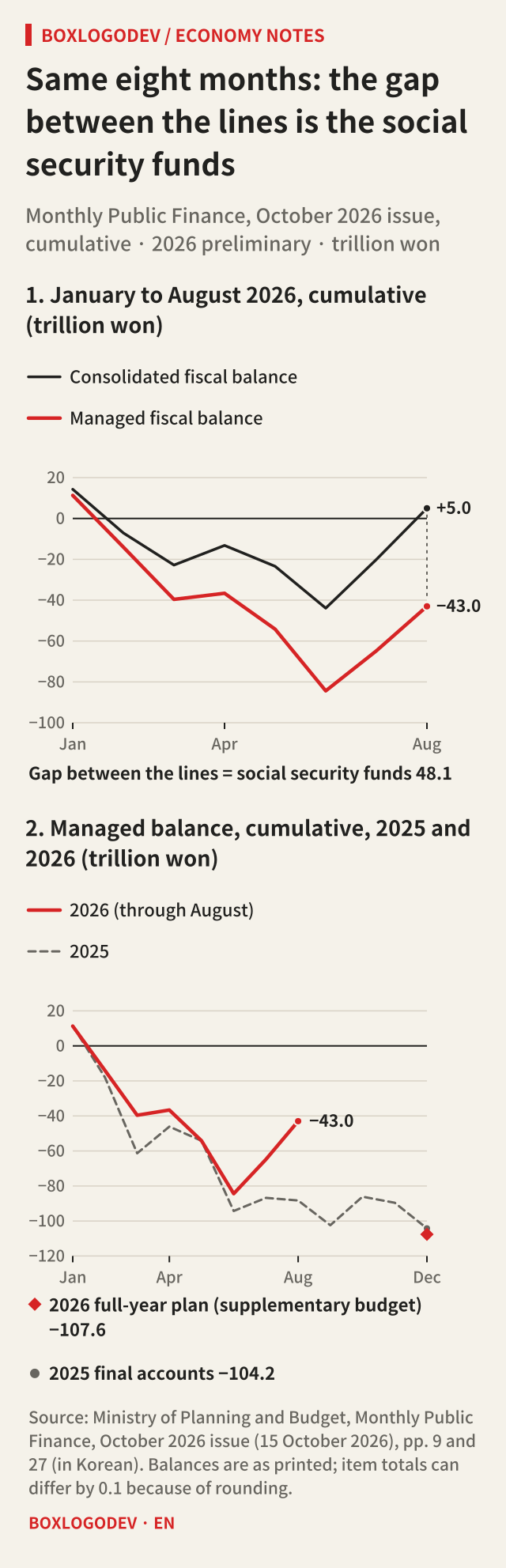
This year the fund balance itself has grown. The 48.1 through August is 13.5 more than the 34.6 at the same point last year. The table shows the consolidated balance 58.8 better than last year but the managed balance 45.3 better. The difference of 13.5 belongs to the funds.
August alone made the 5 trillion won surplus
These balances are running totals from January, so they swing from month to month. The consolidated total went from 14.3 in January down to −43.9 in June and was still −20.1 in July. August revenue of 73.6 and spending of 48.5 made a surplus of 25.1 for the month, bringing the total to 5.0. Of August's national tax revenue of 55.9, corporate tax was 39.7; corporate tax in August last year was 15.9.
The managed balance has the same shape: 11.3 in January, −84.4 in June, −43.0 in August. Earlier years show how unusual this August total is. The consolidated total through August was −31.3 in 2023, −50.4 in 2024, −53.7 in 2025 and +5.0 in 2026; the managed total was −66.0, −84.2, −88.3 and −43.0. Of the four years with monthly figures in the table, only this one has a consolidated surplus through August. Total revenue is up 98.0 from last year, of which national taxes are 69.1. Total spending is up 39.3.
By year-end the numbers look different
The August total is not the year's result. Set the managed balance through August beside the year-end figure for the last three years: −66.0 and −87.0 in 2023, −84.2 and −104.8 in 2024, −88.3 and −104.2 in 2025. In all three the year-end deficit was 15.9 to 21.0 larger than in August. The consolidated balance is mixed: it worsened from −31.3 to −36.8 in 2023, and narrowed from −50.4 to −43.5 in 2024 and from −53.7 to −46.7 in 2025. That does not mean the same will happen again; it is what happened in those three years.
This year's yardstick is the supplementary budget. Revenue of 700.6 and spending of 753.1 give a consolidated balance of −52.5; taking out the funds' 55.1 gives a managed balance of −107.6. Through August, 75.6% of planned revenue and 69.7% of planned spending are done. For the year to end on plan, the last four months would have to come to −52.5 − 5.0 = −57.5 on the consolidated measure and −107.6 − (−43.0) = −64.6 on the managed one. That is subtraction, not a forecast. Plans and results can end up apart: the 2025 final accounts came in 14.1 below the supplementary budget's deficit on the consolidated measure and 7.4 below on the managed one.
ECONOMY NOTES
The August cumulative is not the year-end result
A running total that moves every month, and the full-year figures · trillion won
August alone flipped the sign
5.0 − (−20.1) = 25.1- Consolidated balance through July: −20.1
- August revenue 73.6, spending 48.5
The last three years, August to year-end
- 2023 managed: −66.0 → −87.0
- 2024 managed: −84.2 → −104.8
- 2025 managed: −88.3 → −104.2
2026 full-year plan (supplementary budget)
- Consolidated −52.5, funds 55.1, managed −107.6
- Progress: revenue 75.6%, spending 69.7%
If the plan held, the last four months
−52.5 − 5.0 = −57.5- Managed: −107.6 − (−43.0) = −64.6
- Arithmetic, not a forecast: the 2025 managed deficit ended 7.4 below its supplementary budget
Source: Ministry of Planning and Budget, Monthly Public Finance, October 2026 issue (15 October 2026), pp. 9 and 27 (in Korean). 2026 is preliminary. The figures for the last four months are this article's calculation, not a government forecast.
Two cautions when comparing with annual figures. The ratios to GDP in the table appear only for year-ends: in 2025, −1.7% consolidated and −3.9% managed. The cells for monthly totals are empty, so do not set the August total directly against those ratios. And a balance is not the same as debt. Central government debt at the end of August was 1,372.1, up 104.0 from 1,268.1 at the end of last year. That is not the same as the managed deficit of 43.0 over the same period, and the report's pages on the balance and the debt (pages 9–10) do not link the two item by item.
Three checks when you read about the fiscal balance
First, which balance? Consolidated or managed, and are the social security funds in it? Second, which period? A running total through which month, a full-year plan or the final accounts? Third, is it preliminary? This year's figures are, until the final accounts settle them.
When you see “a surplus through August”, take out the fund balance, then put the same month's total from last year and the full-year plan beside it. Those three numbers show how much can be said. The source is the Ministry of Planning and Budget's Monthly Public Finance, October 2026 issue (in Korean); the revenue table is on page 4, the balance table on page 9 and the monthly table on page 27. Figures through September are due in the November issue, scheduled for 12 November.
Add your perspective.
Share a question, another approach, or something you have tried.
Checking sign-in…
Loading comments…