In the establishment labor survey that Korea's Ministry of Employment and Labor released on 29 October 2026, the real wage per worker in August was 3,409,000 won, 0.8% above the 3,381,000 won of a year earlier. That sounds like pay beating prices. Yet in the same release regular employees' fixed pay rose 2.4% while the consumer price index rose 3.1%. Taken alone, the part of pay that is set in advance, such as base pay, fell behind prices.
After reading this you will be able to recompute the real wage from the published table, and work out the purchasing power of pay with bonuses and the like taken out. You will also know what to check first in next month's table.
A real wage is pay divided by a price index
The release gives the formula: real wage = nominal wage ÷ consumer price index × 100. The index is set to 100 for 2020, so think of it as restating today's pay in 2020 prices. Amounts are before tax and in thousand won.
Plug in the table's numbers. For August 2026, 4,093 ÷ 120.05 × 100 = 3,409.4. For August 2025, 3,937 ÷ 116.45 × 100 = 3,380.9. These match the published 3,409 and 3,381. Then 3,409 ÷ 3,381 = 1.0083, a rise of 0.8%.
Subtracting 3.1% inflation from 3.9% nominal growth also gives 0.8. That subtraction is an approximation; the exact operation is division. 1.039 ÷ 1.031 = 1.0078, so both round to 0.8 this time. It is a shortcut to trust only when the changes are small.
One thing trips up anyone checking the table by hand. The printed 3,937 and 4,093 differ by 156, or 3.96%, but the published change is +155 and 3.9%. The release's notes warn that table figures are rounded, so totals may not add up. The published changes appear to come from unrounded values. This article quotes published changes as changes and uses the printed values for ratios.
ECONOMY NOTES
Recomputing the 0.8% real wage gain
August 2025 vs August 2026 · pre-tax, thousand won; CPI 2020=100
Inputs
- Nominal pay per worker (all workers): 3,937 → 4,093
- Consumer price index: 116.45 → 120.05
Real wage = nominal ÷ CPI × 100
4,093 ÷ 120.05 × 100 = 3,409.4- A year earlier 3,937 ÷ 116.45 × 100 = 3,380.9
- Published 3,409 and 3,381; 3,409 ÷ 3,381 → +0.8%
The same formula on fixed pay (regular employees)
3,713 ÷ 120.05 × 100 = 3,092.9- A year earlier 3,627 ÷ 116.45 × 100 = 3,114.6
- 3,092.9 ÷ 3,114.6 → −0.7% (this article's calculation)
A note on rounding
- The printed 3,937 → 4,093 is +156, or +3.96%
- Published +155 and +3.9%: appears to come from unrounded values
Source: Ministry of Employment and Labor, establishment labor survey release of 29 October 2026, wage tables for August. The real change in fixed pay is not a published item; it is this article's calculation.
Special pay supplied nearly half of regular employees’ rise
Regular employees are those on contracts of a year or more, or on open-ended contracts as regular staff. The release notes that this is a different split from permanent and non-permanent employment. Their pay is divided three ways. Fixed pay is the base pay and allowances set in advance by a contract or work rules. Overtime pay covers overtime, holiday and night work. Special pay covers bonuses, performance pay, back pay from wage rises, tuition aid and similar items. Pay for temporary and daily workers is not broken down this way.
Regular employees' total pay in August was 4,382 thousand won, up 201 thousand won or 4.8% from a year earlier. Fixed pay rose by 86 (+2.4%), overtime pay by 17 (+6.6%) and special pay by 98 (+32.4%). Special pay is only 9.1% of total pay, but its share of the rise is 98 ÷ 201 = 48.8%. The 201 here is the published change, which equals the sum of the three parts. The printed 4,182 and 4,382 differ by 200, which would give 49.0%.
Part of that 32.4% reflects a low base. Special pay in August 2025 was 302 thousand won, 11.1% below the year before. Against the 340 thousand won of August 2024, the two-year rise shrinks to 17.6%. The release does not explain why August special pay rose, so this table cannot say which industries or which payments were behind it.
Now the calculation in the title. It is not a published item, but the same formula works on fixed pay. 3,713 ÷ 120.05 × 100 = 3,092.9 and 3,627 ÷ 116.45 × 100 = 3,114.6, and 3,092.9 ÷ 3,114.6 = 0.9930, a fall of 0.7%. Regular employees' total pay treated the same way goes from 3,591.2 to 3,650.1, a rise of 1.6%. For the same group of employees, the sign depends on whether special and overtime pay are in or out.
Here is a made-up example. Someone paid 3,000,000 won a month in August 2025 would need 3,092,700 won to keep pace with the price index (120.05 ÷ 116.45 = 1.03091). With a 2.4% rise, like the average for fixed pay, the pay is 3,072,000 won. Divided by 1.03091 that buys 2,979,900 won of goods at last year's prices, 20,100 won short. The consumer price index is a national average basket, so the real squeeze differs from person to person.
ECONOMY NOTES
Where regular employees' pay rise came from
August 2026 compared with a year earlier · pre-tax, thousand won
Total pay 4,382 (+201, +4.8%)
- Fixed +86, overtime +17, special +98: sum +201
Fixed pay 3,713 (+86, +2.4%)
- 84.7% of total pay
- Growth below the 3.1% rise in the CPI
Special pay 400 (+98, +32.4%)
- 9.1% of total pay, 48.8% of the rise
- Bonuses, performance pay, back pay, tuition aid and so on
The base a year earlier was low
- August special pay: 340 (2024), 302 (2025), 400 (2026)
- One-year change +32.4%; two-year change +17.6%
Divided by the same price index
- Regular employees' total pay +1.6%, fixed pay −0.7%
- Under 300 staff −0.1%, 300 or more +2.1% (all workers)
Source: Ministry of Employment and Labor, release of 29 October 2026, wage tables. Changes are as published. Shares, the two-year change and the real changes are this article's calculations from the table.
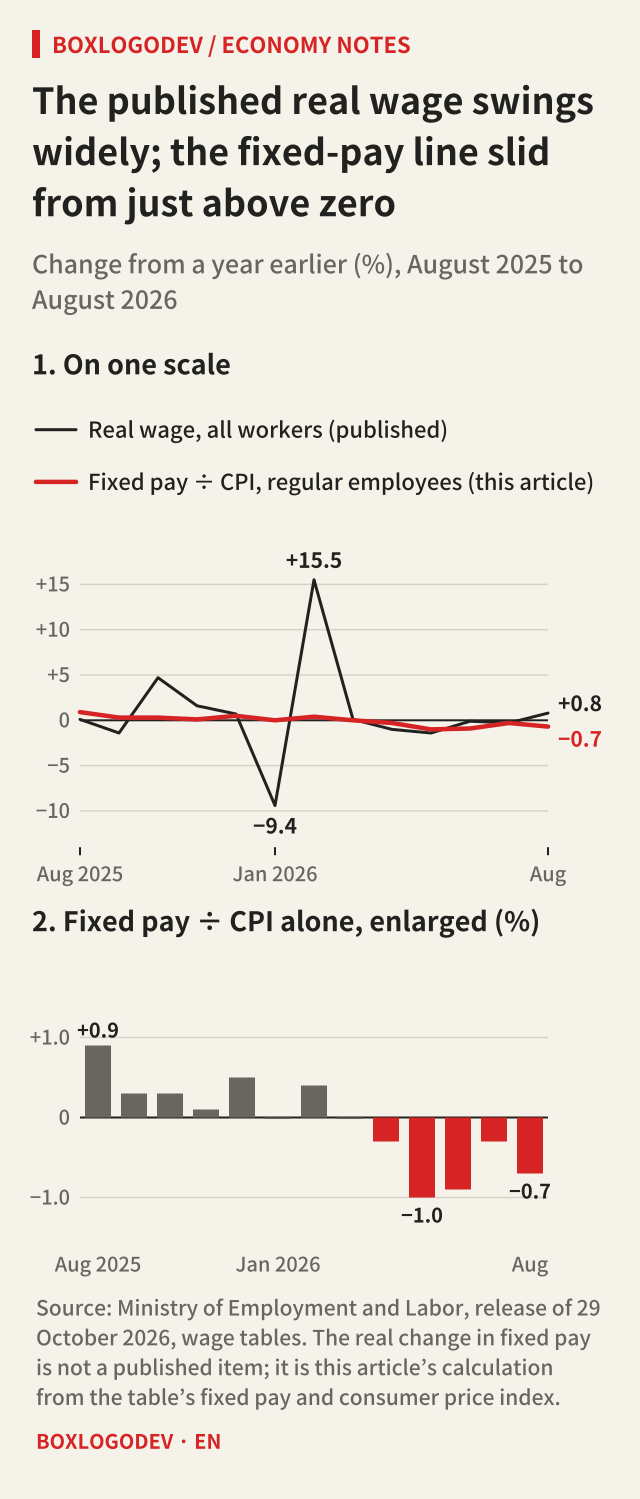
One month's real wage swings widely
The published year-on-year change in the real wage was −9.4% in January 2026 and +15.5% in February. Over those two months, the table's fixed pay divided by the price index changed by 0.0% and +0.4%. Special pay moved −35.7% in January and +140.7% in February; added together, the two months went from 1,840 to 2,097 thousand won, up 14.0%. The release's questions and answers give an example: if the Lunar New Year bonus is paid in January one year and in February the next, February's growth can look large. January and February in this table have that shape, but the release does not state the cause for these two months.
So the trend is easier to see on the fixed-pay side. Over the 13 months from August 2025 the published real wage change ranged from −9.4% to +15.5%, while fixed pay divided by the price index stayed between −1.0% and +0.9%. From April to August 2026 it was −0.3, −1.0, −0.9, −0.3 and −0.7%, five negative months in a row. Over that stretch fixed pay growth held at 2.1–2.5% and inflation ran higher, at 2.6–3.2%.
Simply adding up the table's months for January to August, the real wage went from 28,586 to 28,665, up 0.3%, and fixed pay divided by the price index went from a monthly average of 3,130.0 to 3,118.7, down 0.4%. These are this article's sums, not a cumulative figure from the Ministry. It has not always been negative, though. A year earlier, in August 2025, the same calculation gave +0.9%, and against August 2024 it is still +0.2%.
What these numbers do not say
First, this is an average. As the release explains, it is the total wage bill divided by the number of workers, so special pay concentrated in some establishments still lifts it. Dividing all workers' pay by size of establishment with the same price index, establishments with under 300 staff go from 3,059.7 to 3,056.2, down 0.1%, and those with 300 or more from 4,923.1 to 5,027.9, up 2.1%. This table cannot show what happened to any one person's pay, and the average also moves when the mix of workers changes.
Second, the survey has limits. The wage statistics cover a sample of about 13,000 establishments with at least one regular employee, and leave out bodies employing civil servants, agriculture, forestry and fishing, and domestic services, among others. The amounts are pre-tax, so changes in tax burdens are not in them.
Third, from January 2026 a revision of the industry classification took social security insurance and pension businesses out of finance and insurance and out of the survey. The release asks for particular care with year-on-year comparisons for finance and insurance. It does not give the size of the effect on the overall average.
How to read the next table
First check the published real wage, then set fixed pay growth beside inflation and see which is larger. Next check the change in special pay and its value a year earlier, because the real wage in a month with a big special pay move carries that move too. Judge over several months rather than one.
The source is the wage tables in the Ministry of Employment and Labor release for the September 2026 survey (in Korean). Wages appear a month behind the survey month, so the wages in this release are for August. In the last three months the release came out at the end of the month, so September wages look likely around the end of November, but this article could not confirm the date. When the table appears, start by subtracting inflation from fixed pay growth.
Add your perspective.
Share a question, another approach, or something you have tried.
Checking sign-in…
Loading comments…