Open a book of myths and find Confucius, Laozi, Wu Zixu and the First Emperor in the contents, and you may be puzzled. That is volume 2 of Chinese Myths and Legends, number 17 in Minumsa's World Literature series, written by Yuan Ke (1916–2001) and translated into Korean by Jeon In-cho and Kim Seon-ja. It consists of one part, on the Zhou and Qin, and its section titles are full of people's names. The likeliest reason is that the author's idea of myth was wide. After reading this guide you will be able to explain why they are likely in the book, and to read each section by separating the oldest record from what grew on it.
This reading guide follows the guide to volume 1. Where that one took up story order and record order, this one takes up the border between myth and history. It does not quote or compare the wording of the Minumsa edition, and the renderings of the old texts are its own.
What kind of book is volume 2?
By the publisher's listing, volume 2 came out on 15 February 1999 at 400 pages, and its contents show the 21 sections of Part 6 plus a commentary. Grouped by section title alone, that makes five on Zhou kings and court, six on thinkers, three on Wu and Yue, three on swords, love and music, and four on the First Emperor. This guide made those groups. What "Yongmo" means in the section title on the First Emperor's tomb could not be confirmed from the contents alone.
READING NOTES
Volume 2: 21 sections in five groups
One part, on the Zhou and Qin · 400 pages
Zhou kings and court · 5
- King Mu and the Queen Mother of the West
- King Xuan and Du Bo
- King You and Bao Si
- King Ling and Chang Hong
- Shi Kuang and Wangzi Qiao
Thinkers · 6
- Confucius and Xiang Tuo
- Confucius and Laozi
- Confucius and his disciples
- Zeng Shen and Gongye Chang
- Laozi and Mozi
- Mozi and Lu Ban
Wu and Yue · 3
- Wu Zixu and Helü
- Fuchai and Goujian
- Wu Zixu's death and Fan Li
Swords, love, music · 3
- Ganjiang and Moye
- Han Zhong, Ziyu and the lovesick tree
- Bo Ya, Zhong Ziqi and Baili Xi
The First Emperor · 4
- The assassin Jing Ke
- The three sacred mountains
- The Great Wall and Meng Jiangnü
- His tomb and the 'Yongmo' legend
5+6+3+3+4=21 · this guide grouped the section titles · the book has no such groups
How did it get this far?
According to a 2024 article in Chinese Social Sciences Today, Yuan Ke's first book of 1950 ended with the Xia dynasty, and as he revised and enlarged it, the lower limit of the story came down to the Zhou and Qin. Alongside that stands the idea of "broad myth" he put forward in the early 1980s; linking the two is this guide's reading. Myth, he held, is an open system rather than something closed in the past, and new myths arise in every period of class society as well as in primitive society. He set out nine branches: primitive myth, legend with a mythic character, history turned into myth, immortals' tales (mainly Daoist myth), part of the fiction of marvels, fairy tales with a mythic flavor, Buddhist scripture myth, myths and legends of festivals, magic, treasures, customs and local features, and the myths and legends of minority peoples.
This definition was not a settled consensus. After Yuan Ke published "Broad Myth Revisited" in 1984, the same journal promptly ran a debate on defining myth with more than twenty scholars, and opinion reportedly divided. So the answer to "why is Confucius in a myth book?" is that Yuan Ke's definition lets him in. Under another definition he might stay out.
The Queen Mother of the West: three forms of one name
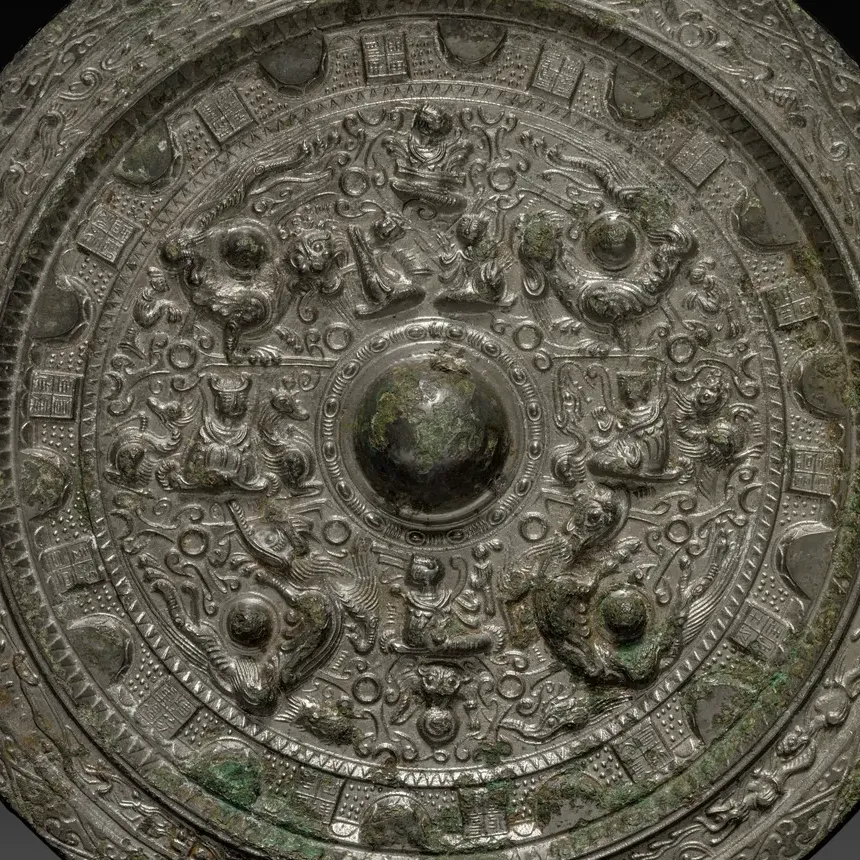
The Queen Mother of the West, in the first section, shows the range well. In the "Xi shan jing" of the Shanhaijing she has a human shape but a leopard's tail and a tiger's teeth, is good at whistling, and wears an ornament in her wild hair. The Mu tianzi zhuan is a bamboo-slip book said to have come out of an old tomb at the end of the third century. In it King Mu of Zhou travels to her country and presents gifts, and the two share a cup above the Jade Pool and exchange songs. Eighteenth-century editors of the imperial catalogue read the Queen Mother of this book as merely the ruler of a western country.
On a mirror of about the fourth century she is a deity paired with the King Father of the East. The Cleveland Museum of Art reports a legend that the two meet once a year, standing for the meeting of yin and yang. Set the leopard-tailed being, the ruler a king visits and the goddess on the mirror side by side, and the first question becomes whether this is one figure changing or different beings sharing a name.
READING NOTES
The Queen Mother of the West: three records, three forms
Side by side, not in date order
Shanhaijing, 'Xi shan jing'
- Human shape, leopard's tail, tiger's teeth
- Good at whistling, ornament in her wild hair
Mu tianzi zhuan
- Ruler of a country King Mu travels to
- Shares a cup above the Jade Pool and exchanges songs
Mirror, c. 317–400 CE
- Deity paired with the King Father of the East
- U-shaped crown; legend of a yearly meeting
This does not settle whether it is one figure changing or different beings sharing a name
Meng Jiangnü: the woman who did not wail
Of the 21 sections, "The Great Wall and Meng Jiangnü" is probably the one whose changes can best be traced. In the Zuo zhuan, under Duke Xiang's 23rd year (550 BCE), a soldier of Qi named Qi Liang dies in battle. Returning home, the ruler of Qi sends condolences to his widow in the open country. She declines to receive them there, and he goes to her house to pay them. There is no wailing, no falling wall and no name for her.
In the Mencius ("Gaozi II") there is one remark that the wives of Hua Zhou and Qi Liang wailed so well for their husbands that they changed the customs of the state. In Liu Xiang's Lienü zhuan of the first century BCE, Qi Liang's wife wails beside the body, the city wall falls after ten days, and she drowns herself in a river. The setting is still Qi. In "Qi Liang's Wife" by the monk-poet Guan Xiu (832–912), who lived from the late Tang into the Five Dynasties, the first lines speak of Qin's lawlessness and the building of the Long Wall; she wails, the wall falls, and Qi Liang's bones appear. From 550 BCE to Guan Xiu is about 1,400 years.
READING NOTES
How a widow became Meng Jiangnü
From a funeral anecdote to a falling Great Wall
Events of 550 BCE · Zuo zhuan
- Qi Liang's widow declines condolences in the open.
- No wailing and no falling wall.
c. 300s BCE · Mencius
- The wives of Hua Zhou and Qi Liang wail.
- One remark: it changed the state's customs.
1st c. BCE · Lienü zhuan
- After ten days of wailing, a city wall falls.
- The setting is still the state of Qi.
Late Tang · a poem by Guan Xiu
- The setting is now labor on Qin's Long Wall.
- She wails; the wall falls; his bones appear.
About 1,400 years separate 550 BCE and Guan Xiu (832–912)
One account says the name Meng attaches in the Tang, and the First Emperor enters as a character in versions from about the Song. Gu Jiegang traced these changes in the 1920s, and Wilt Idema has criticized the readings of scholars of that time as reflecting their own new worldview. So the link between this legend and the actual Qin wall was not there from the start.
Stories Sima Qian had already sifted
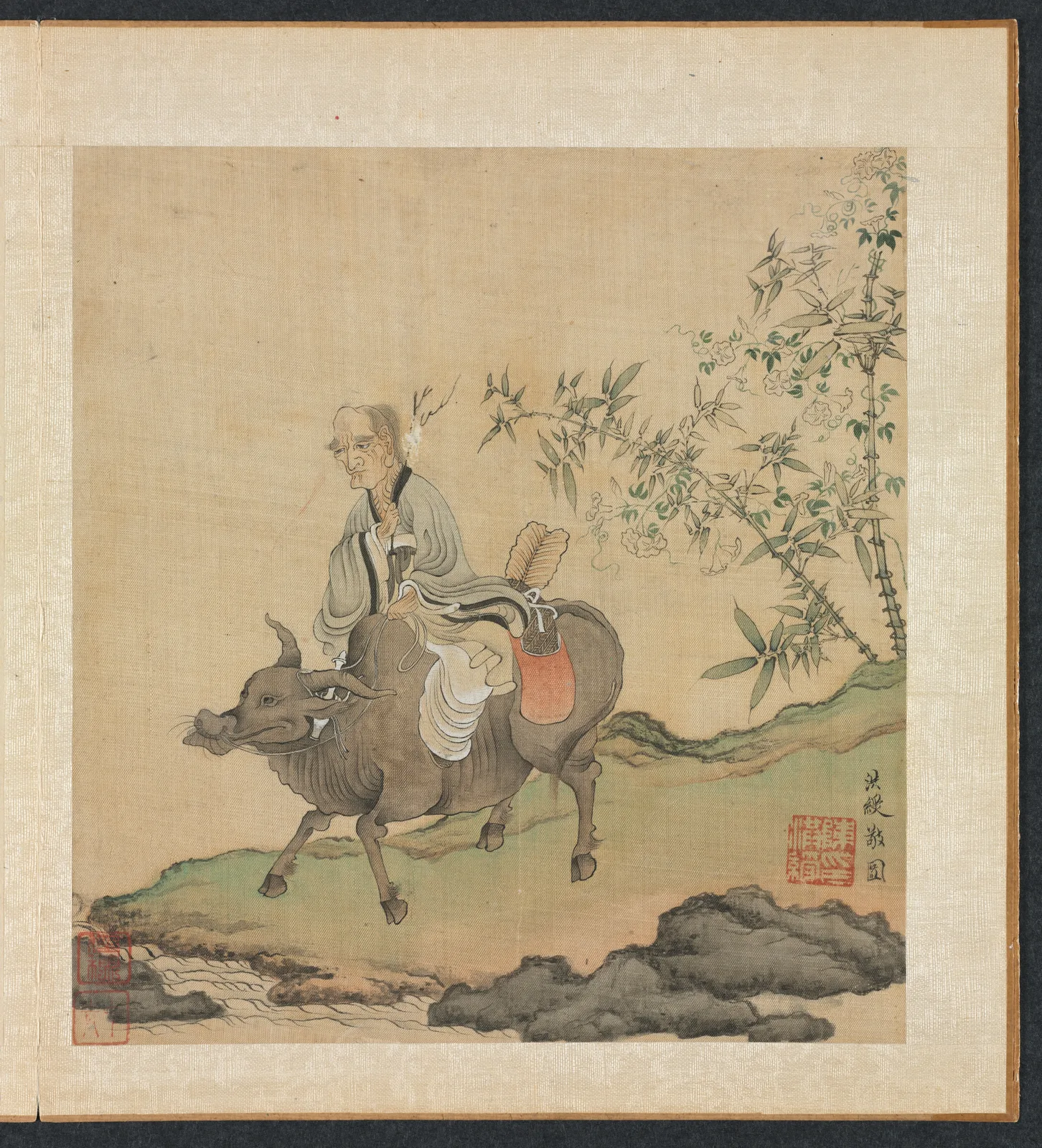
Even inside the history books the border blurs. Sima Qian's Shiji records that after meeting Laozi, Confucius said he was like a dragon. On Laozi himself it leaves the questions open: he wrote a book at a pass and left, and no one knows where he died; he lived over 160 or over 200 years; some said the Grand Historian Dan was Laozi, and the world does not know if that is so. The Liexian zhuan, a set of immortals' biographies, has him leave in a cart drawn by a green ox. In a painting by Chen Hongshou, who lived from the late Ming into the early Qing, he sits on the ox's back.
At the end of his chapter on assassins, Sima Qian writes that when the world tells of Jing Ke, its talk of the fate of Prince Dan of Yan, with grain raining from heaven and horses growing horns, goes too far. So legends were already attached in his day. By contrast, the entry for the First Emperor's 28th year (219 BCE) simply relays what the adept Xu Fu told him: that three sacred mountains, Penglai, Fangzhang and Yingzhou, lay in the sea with immortals on them; and Xu Fu set off with several thousand boys and girls. The seed of "Confucius and Xiang Tuo" shows in the Shiji too: one remark in which the boy Gan Luo says Xiang Tuo became Confucius's teacher at seven. The same claim is in the earlier Huainanzi ("Xiuwu"), so the Shiji is not the oldest record. How a line in a history later grows into a story is worth following through volume 2.
How to read it
Before each section, ask three things. What is the oldest record, in which book and passage? What was added after it? Who might have needed that addition? The answer to the last is usually interpretation, so it is better not to state it flatly. The World Literature edition has no detailed notes, so to find sources, keep volume 2 of the 2002 annotated edition (454 pages) or the Shiji itself to hand. The cases here are only some of the 21 sections, and how the book narrates each passage has to be checked in its own text.
If you remember one thing from volume 2, do not stop at "did this person exist?" Ask "since when has this scene existed?" Myth grows even beside a Confucius and a First Emperor who were real.
Add your perspective.
Share a question, another approach, or something you have tried.
Checking sign-in…
Loading comments…