In the Bank of Korea's survey of the lending behaviour of financial institutions (Q3 2026 trends and Q4 2026 outlook, released in Korean on 26 October 2026), domestic banks' lending attitude index for household general loans was −28 for the third quarter and −8 for the fourth-quarter outlook. Household general loans are household loans not tied to housing, such as credit loans and overdraft lines. It is tempting to read −28 as "28% of banks tightened lending", but that is not how the index works.
By the end of this note you will be able to recompute −28 and −8 yourself from possible mixes of answers by the 18 banks. You will also be able to say how few or how many banks may have tightened behind the same −28, and why 0 does not mean that credit is easy to get.
Eighteen banks each pick one of five answers
The lending survey is a quarterly questionnaire the Bank of Korea sends to the officer in charge of lending at each financial institution. This round ran from 2 to 16 September and covered 203 institutions. Eighteen of them are domestic banks, including three internet-only banks, and all 18 answered. The questions are how lending attitudes changed over the past three months (July to September) and how they will change over the next three (October to December). The Q3 figure of −28 answers the first question, the Q4 figure of −8 the second.
The answer is one of five: eased a lot, eased somewhat, no change, tightened somewhat, tightened a lot. The survey outline on page 6 of the release's attachment gives the formula: [(share answering eased a lot × 1.0 + share answering eased somewhat × 0.5) − (share answering tightened a lot × 1.0 + share answering tightened somewhat × 0.5)] × 100. The index therefore lies between −100 and 100. The outline explains that a positive value means more institutions answered "eased" than "tightened", and a negative value the opposite. Strictly, it means the weighted easing answers outweigh the weighted tightening answers, and once "a lot" answers are in the mix that can differ from the head count: five banks easing somewhat and four tightening a lot give (2.5 − 4) ÷ 18 × 100 = −8.3, or −8, even though more banks eased.
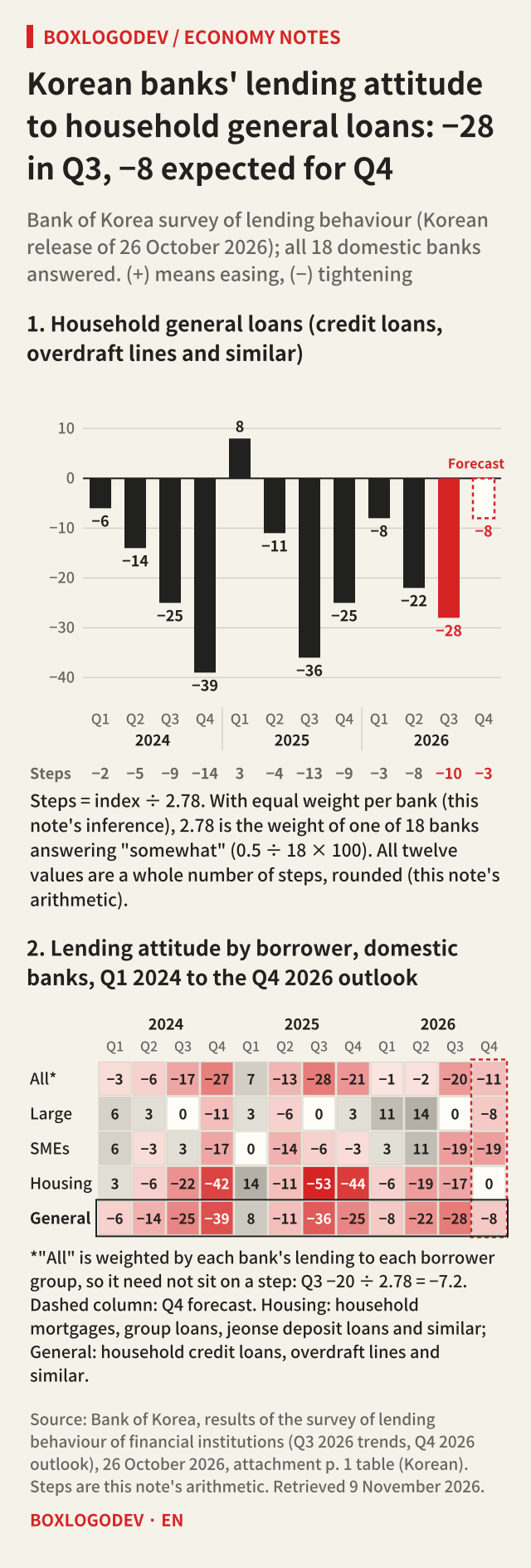
Lending attitude is asked separately for each group of borrowers: large firms and small and medium-sized firms on the corporate side, and on the household side, housing loans (mortgages, group loans for new flats, jeonse deposit loans) and general loans (credit loans, overdraft lines). Figure 1 shows the values in this release from the first quarter of 2024 to the fourth-quarter outlook for 2026. Household general loans were negative in all of these twelve quarters (the last one a forecast) except the first quarter of 2025 (8).
One bank answering "somewhat" is 2.78 points
In the borrower-level indices, a "share" in the formula can be taken as the proportion of the 18 banks that chose that answer (that each bank carries the same weight is an inference from the figures, as shown below). One bank is 1 ÷ 18 = 5.56%. If that bank answers "tightened somewhat", the weight of 0.5 applies and the index falls by 0.5 ÷ 18 × 100 = 2.78 points; "tightened a lot" takes it down 5.56 points. Easing answers push it up by the same amounts.
Now rebuild −28. If 10 banks tightened somewhat and the other 8 reported no change, the index is −(10 ÷ 18 × 0.5) × 100 = −27.8, which rounds to −28. The Q4 outlook of −8 equals −8.3, what three banks tightening somewhat and fifteen reporting no change would give, rounded. The second-quarter −22 equals −22.2, from eight banks tightening somewhat.
ECONOMY NOTES
Recomputing −28 and −8 from possible answer mixes
Index = [(eased a lot × 1.0 + eased somewhat × 0.5) − (tightened a lot × 1.0 + tightened somewhat × 0.5)] × 100. With equal weight per bank (this note's inference), each answer is a share of 18 banks
What one bank weighs
- 18 domestic banks, all 18 answered
- One bank's share: 1 ÷ 18 = 5.56%
- One "somewhat": 0.5 ÷ 18 × 100 = 2.78 points
- One "a lot": 1.0 ÷ 18 × 100 = 5.56 points
Household general loans, Q3: −28
- Example: 10 tightened somewhat, 8 no change
- −(10 ÷ 18 × 0.5) × 100 = −27.8
- Rounded to a whole number: −28
Household general loans, Q4 outlook: −8
- Example: 3 tightened somewhat, 15 no change
- −(3 ÷ 18 × 0.5) × 100 = −8.3
- Rounded to −8, still on the tightening side
0 means no net change, not easy credit
- All 18 report no change → 0
- 9 eased somewhat + 9 tightened somewhat → 0
- The index asks how attitudes change over three months (past or expected), so it says nothing about how high the bar is
The answer mixes are possible examples that give the published figures, not actual answers of any bank. Formula and number of banks: Bank of Korea release of 26 October 2026, attachment p. 6 (Korean). Equal weight per bank is this note's inference.
The release publishes the index only, not how each bank answered. The mixes above are therefore examples that can produce the published figures, not a claim that 10 banks actually answered "tightened somewhat".
The same −28: 5 banks may have tightened, or 15
More than one mix gives −28. Five banks tightening a lot and 13 reporting no change also give −5 × 1.0 ÷ 18 × 100 = −27.8. So do three banks tightening a lot plus four tightening somewhat, or 12 tightening somewhat plus two easing somewhat. Easing and tightening answers offset each other, so even 15 banks tightening somewhat with three answering on the easing side (one somewhat, two a lot) comes out at −28.
Counting every way to split 18 banks among the five answers, 175 combinations of answer counts round to −28, with as few as 5 banks tightening (27.8%) or as many as 15 (83.3%). Even with no easing answers at all, it is somewhere from 5 to 10 banks. "28% of banks tightened" is right only if all five tightening banks tightened a lot; with no easing answers and every tightening answer "somewhat", 10 banks, or 56%, tightened.
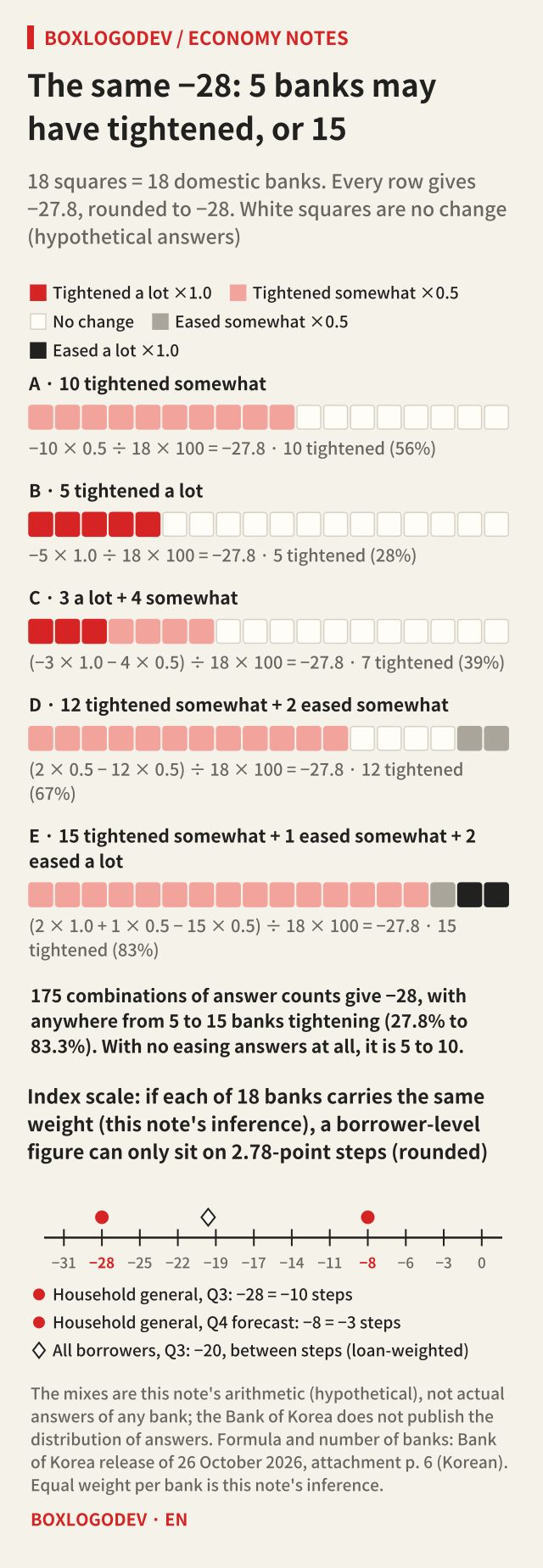
The index, in other words, is not a share of banks but the difference between the weight on the easing side and the weight on the tightening side. With equal weight, it cannot tell two banks that tightened somewhat from one that tightened a lot.
Zero does not mean loose
Because the questions ask how attitudes changed over the past three months (trends) and how they will change over the next three (outlook), the index shows the direction of movement, not how high the bar for borrowing is. All 18 banks reporting no change give 0, and so do nine easing somewhat against nine tightening somewhat. Either way, 0 means no net change over those three months (or, in an outlook, none expected), not that loans are easy to get.
In this release, the Q4 outlook for household housing loans is 0. The Bank of Korea explains that banks expect to keep their attitude to housing-related loans where it was last quarter, partly because they have secured more room to lend, while general loans such as credit loans remain on a tightening course. The Q4 outlook of −8 for household general loans should likewise be read as a smaller net balance toward tightening (−10 steps to −3, at 2.78 points a step), not "the tightening is over". It does not mean fewer tightening answers: five banks tightening a lot in Q3 and, for the Q4 outlook, ten tightening somewhat against seven easing somewhat would also give −28 and −8. On a net basis, it says the bar raised in Q3 will be raised a little further in Q4.
Borrower-level figures sit only on 2.78-point steps
If one bank answering "somewhat" is worth 2.78 points, a borrower-level index has to be a whole multiple of 2.78, rounded. This note checked all 132 borrower-level figures in the release for lending attitude, credit risk and loan demand, from Q1 2024 to the Q4 2026 outlook, and every one sits on that step. The "Steps" row in the upper part of Figure 1 is the household general index divided by 2.78: −28 for Q3 is −10 steps, −8 for the Q4 outlook is −3 steps.
The outline describes the index only in terms of the shares of answers and the number of institutions giving each answer; it does not say outright that each bank carries the same weight in the borrower-level indices. Trying every number of banks from 10 to 40, only 18, 32 and 36 fit all 132 values, and this survey has 18 domestic banks. That the borrower-level indices count each bank once, as a simple share, is therefore this note's inference from the pattern of the figures. The release does not say whether there were also 18 domestic banks in the 2024 quarters.
The composite index is different. The table note says it is a weighted average using each bank's loans to each borrower group. Because the answers are mixed in proportion to those loan amounts, there is no reason for it to sit on a step. The Q3 composite of −20 divided by 2.78 is −7.2 steps, between two steps. The Q4 outlook of −11 happens to match −4 steps (−11.1), but 7 of the 12 composite lending attitude figures since Q1 2024 do not sit on a step.
The size of the step matters when reading small moves. Household general loans going from −22 in Q2 to −28 in Q3, a 6-point drop, is a net change worth two "somewhat" answers. A difference of about 3 points can be no more than one bank moving its answer by one notch.
Reading the next release
When you see a borrower-level lending attitude index, first check how many domestic banks answered in the response-rate table of the outline at the end of the release. Assuming, as inferred above, that each bank counts once, divide the index by 2.78 if all 18 answered, as this time, or by 50 ÷ N if N banks answered. The number of steps is the net balance of tightening over easing, counted in "somewhat" answers. How many banks tightened cannot be pinned down from the index; it can only be given as a range. With no easing answers and every tightening answer "somewhat", the number of steps equals the number of banks that tightened; the more "a lot" answers there are, the fewer banks it takes. The division does not work for the composite index, which is weighted by loan amounts.
The figures here are from the 26 October release, checked on 9 November 2026. The outline says the index is published in the month after each quarter ends (January, April, July and October), so the next values, Q4 2026 trends and the Q1 2027 outlook, are due in January 2027. The exact date is not listed on the Bank of Korea's statistical release calendar. The survey closed on 16 September, so policy or rate decisions announced after that do not change these numbers.
Survey indices are not all read against the same baseline. The indices covered in Four of its six components are below 100. Why is consumer sentiment 106.6? and In September the CBSI fell 0.5 points and the ESI rose 0.5. Which should you read? are read against a long-run average of 100; the lending attitude index counts the difference between easing and tightening answers around 0.
Add your perspective.
Share a question, another approach, or something you have tried.
Checking sign-in…
Loading comments…