Triceratops is remembered by its head alone — true to its name, the three-horned face. Including the frill, the shield behind its neck, the skull approaches a metre across and is one of the largest and most striking heads of any land animal. Alongside the basic record, this guide adds the structure of that head, how it defended itself, and the story of a dinosaur first mistaken for a giant bison.
The record at a glance
| Scientific name | Triceratops horridus is the best-known species. Named by Othniel Charles Marsh in 1889. The genus is now organised into two species, horridus and prorsus. |
|---|---|
| Name meaning | 'Three-horned face', from Greek. |
| Era | Late Cretaceous, about 68–66 million years ago. It shared its world with Tyrannosaurus. |
| Length | Estimated at about 9 metres. |
| Weight | Estimates range widely, about 6–12 tonnes, depending on the specimen and the method — so a range is given. |
| Diet | Herbivorous. A parrot-like beak snipped plants, and rows of teeth at the back of the jaw ground up tough vegetation. |
| Found in | Late Cretaceous rocks of the USA. |

The build — everything invested in the head
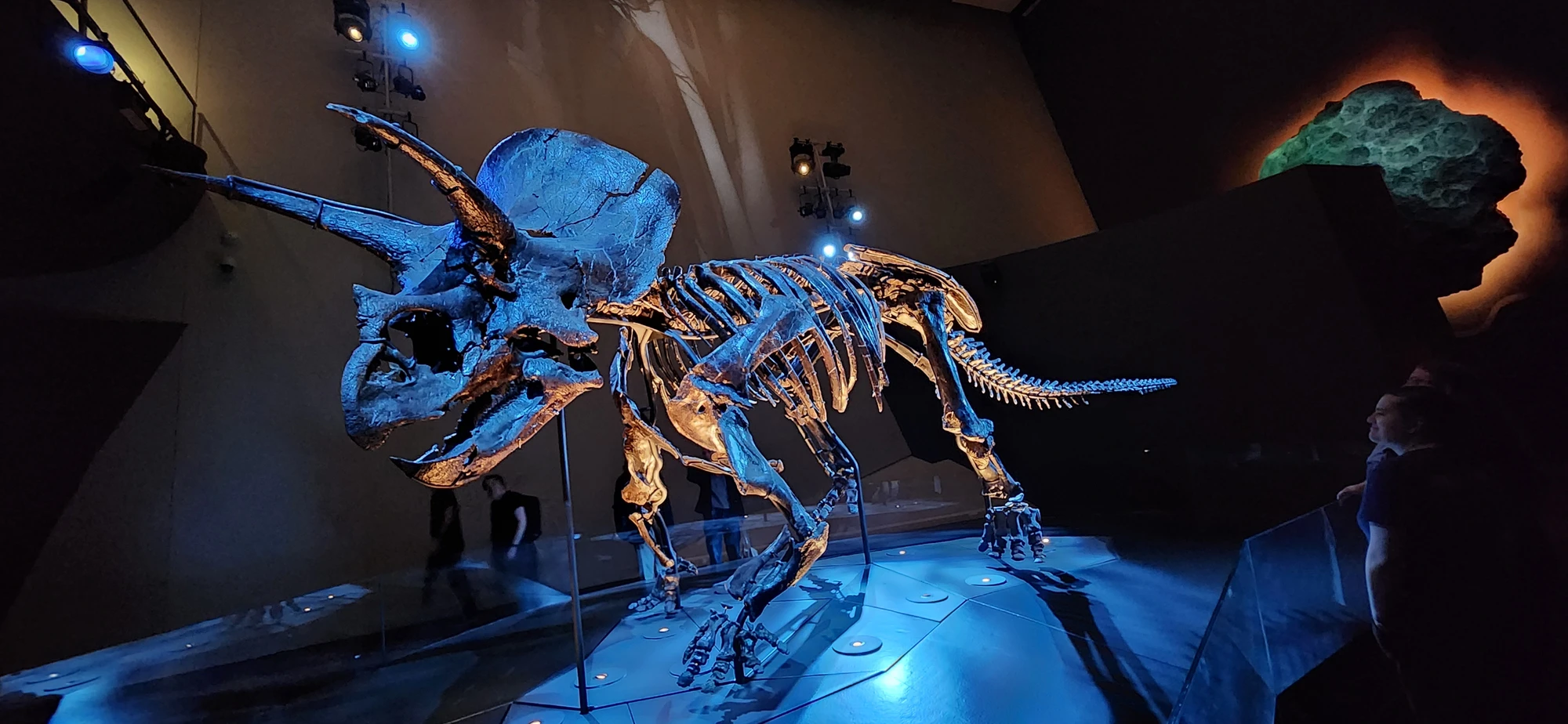
Every famous feature of Triceratops sits on its head: two horns above the eyes, one on the nose, and behind them the wide bony shield called the frill, which could reach nearly a metre across. The whole skull is among the largest and most striking of any land animal. What fossils preserve is only the bony core of each horn; in life a sheath of keratin — the material of our fingernails — covered them, so the living horns were longer and sharper than the fossils suggest.
The body left records too. Skin impressions have been found, showing large, pebbled scales. It walked on four legs, snipped vegetation with its beak and ground it with shearing rows of teeth. It probably fed mostly on low-growing plants, though it could raise its head to reach somewhat higher, and may have used its frill and horns to push through dense growth while feeding.

Size comparisons — bus-length, up to two elephants
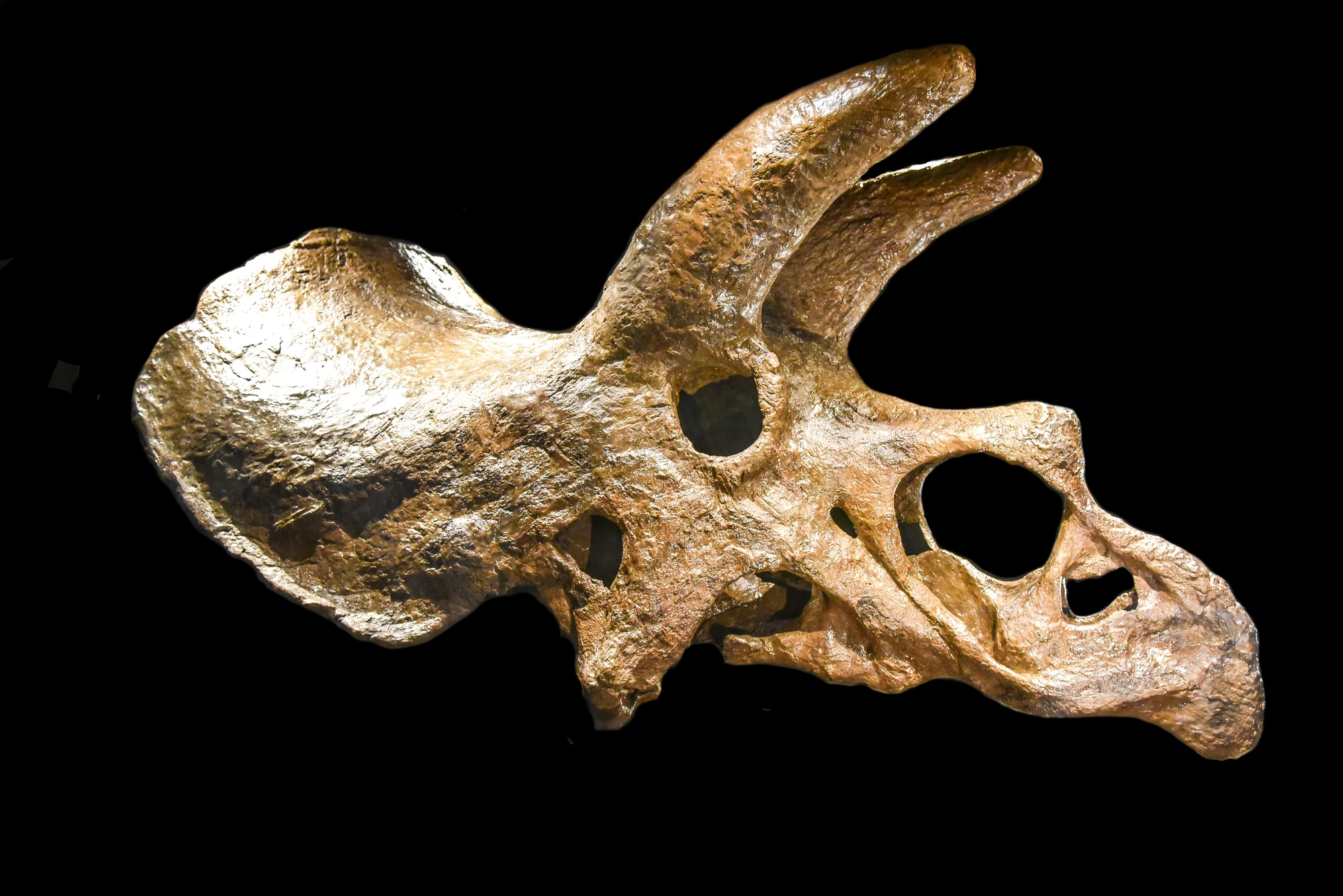
A length of about 9 metres is a little less than a city bus. The weight estimates, 6–12 tonnes, span one to two African elephants. The head is the real outlier: with a frill approaching a metre across, the animal carried a shield about as wide as an adult's outstretched arms on top of its neck. Facing it head-on, a predator met three horns and that shield before anything else.
Defence and fighting — the record on the horns
The fossils answer part of the question of what the horns and frill were for. A specimen collected in 1997 has a horn that was bitten, with marks matching Tyrannosaurus teeth — and the bite had healed, so at least that individual survived an attack by a large predator. Puncture marks on fossil frills support the idea that Triceratops also fought each other with their horns, probably contests between males.
The frill was not a perfect shield, though: other specimens show Tyrannosaurus teeth puncturing it, so its protection of the neck had limits. That is why the frill's roles are also sought in display — attracting mates, or letting members of the species recognise each other. What the fossils settle is only that the horns were genuinely used in fights.

Discovery — first taken for a giant bison
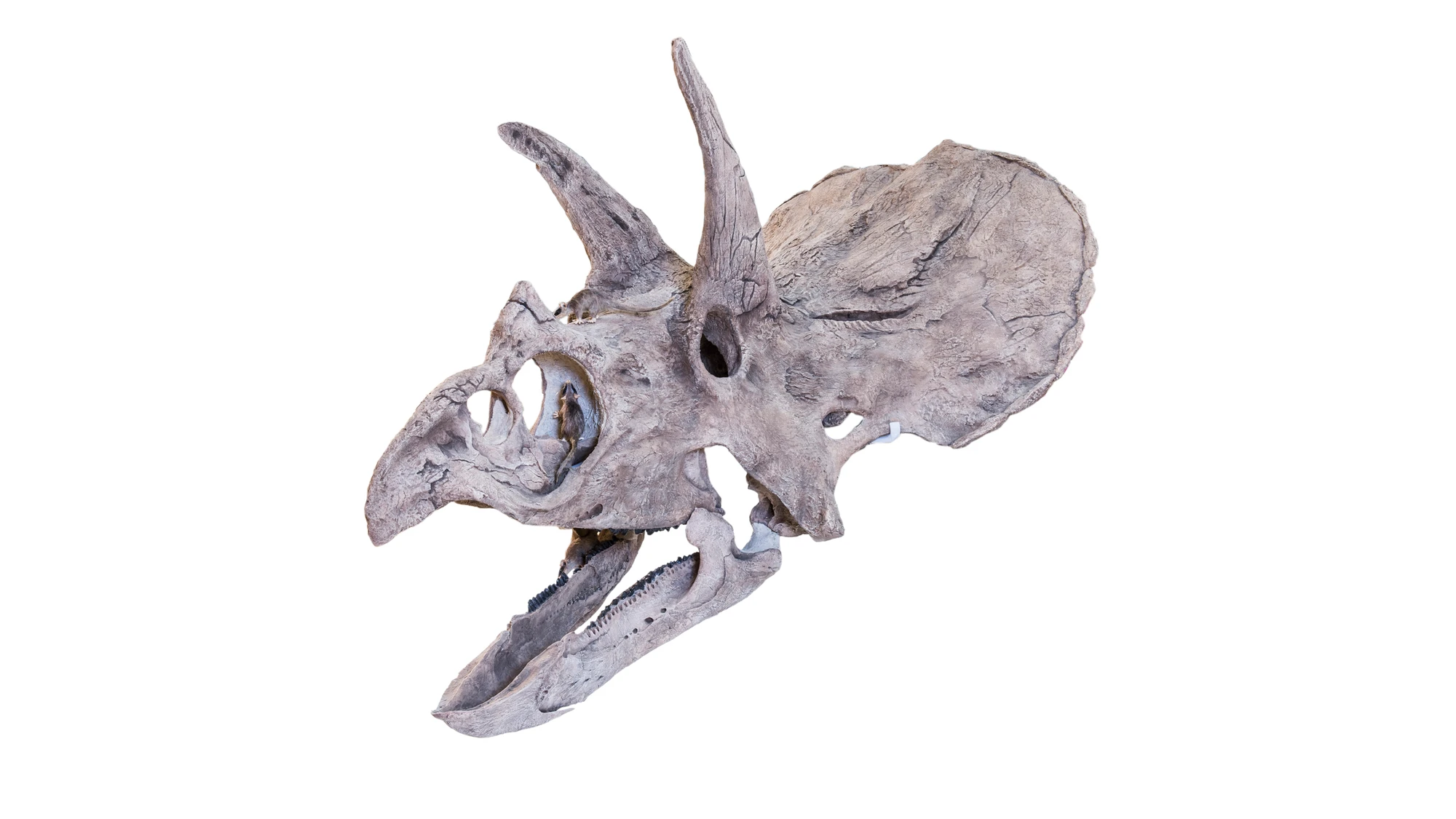
The discovery of Triceratops began with a mistake. In 1887 the American scientist Othniel Charles Marsh obtained a pair of horn cores and took them for the horns of a giant bison, naming his find Bison alticornis. As more bones came out of the ground, the three-horned dinosaur emerged, and the name became Triceratops.
Skulls kept turning up in a variety of shapes and sizes, which once suggested many species. Today the genus is organised into just two species, horridus and prorsus, and the variety is read as individuals simply looking quite different from one another. Triceratops is often compared to a rhinoceros, but the two are unrelated — one a dinosaur, the other a mammal. Similar lives as large, horned plant-eaters made them look alike, nothing more.
Did it live in herds? Still open
Many other horned dinosaurs are known to have lived in herds because many individuals are found together in one place. Triceratops is unusual: its remains are usually found individually, which suggests it may have spent much of its life alone. Herds can warn each other of danger and dilute the chance of any one animal being picked off, so the fossil pattern runs against the family habit. There is still a distance between "few fossils found together" and "it actually lived alone", and this guide keeps that distance.
Where to see one in Korea
No Korean museum in the range checked keeps a full Triceratops skeleton on permanent display. For dinosaur skeletons in general, the Geological Museum in Daejeon and the National Science Museum's natural history hall, also in Daejeon, are the closest stops. The special exhibition "Footprints of Giants: Sauropod Dinosaurs" at the Jinju Pterosaur Tracks Museum (until 28 February 2027) is announced to include a full Triceratops skeleton. It is a limited-run exhibition, so check the museum's notices before visiting.
Sources
- Natural History Museum, London — Dino Directory, "Triceratops" — nhm.ac.uk
- Jinju Pterosaur Tracks Museum special exhibition announcement (Jinju City) — covered together in the dinosaur exhibitions guide.