Brachiosaurus is the sauropod whose front legs are longer than its back legs, so the body tilts up towards the front. The 'arm' in its name comes from exactly those long front legs. Alongside the basic record, this guide adds the animal's build, its unusual way of digesting, and the story of a reconstruction that had to borrow a relative's bones because no complete skeleton exists.
The record at a glance
| Scientific name | Brachiosaurus altithorax. Named by Elmer S Riggs in 1903. |
|---|---|
| Name meaning | 'Arm lizard' — its front legs, its arms, were longer than its back legs. |
| Era | Late Jurassic, about 152–145 million years ago. |
| Length | Estimated at about 22 metres. |
| Weight | Estimates vary widely. The Natural History Museum's directory gives 46,900 kg, and lighter estimates exist, so this guide uses a range of about 30–47 tonnes. |
| Diet | Herbivorous. It likely fed on the leaves of tall trees such as conifers and tree ferns, swallowing them whole and fermenting them in its gut. |
| Found in | First found in Colorado, USA, in 1900 — at the time, the largest dinosaur known. |
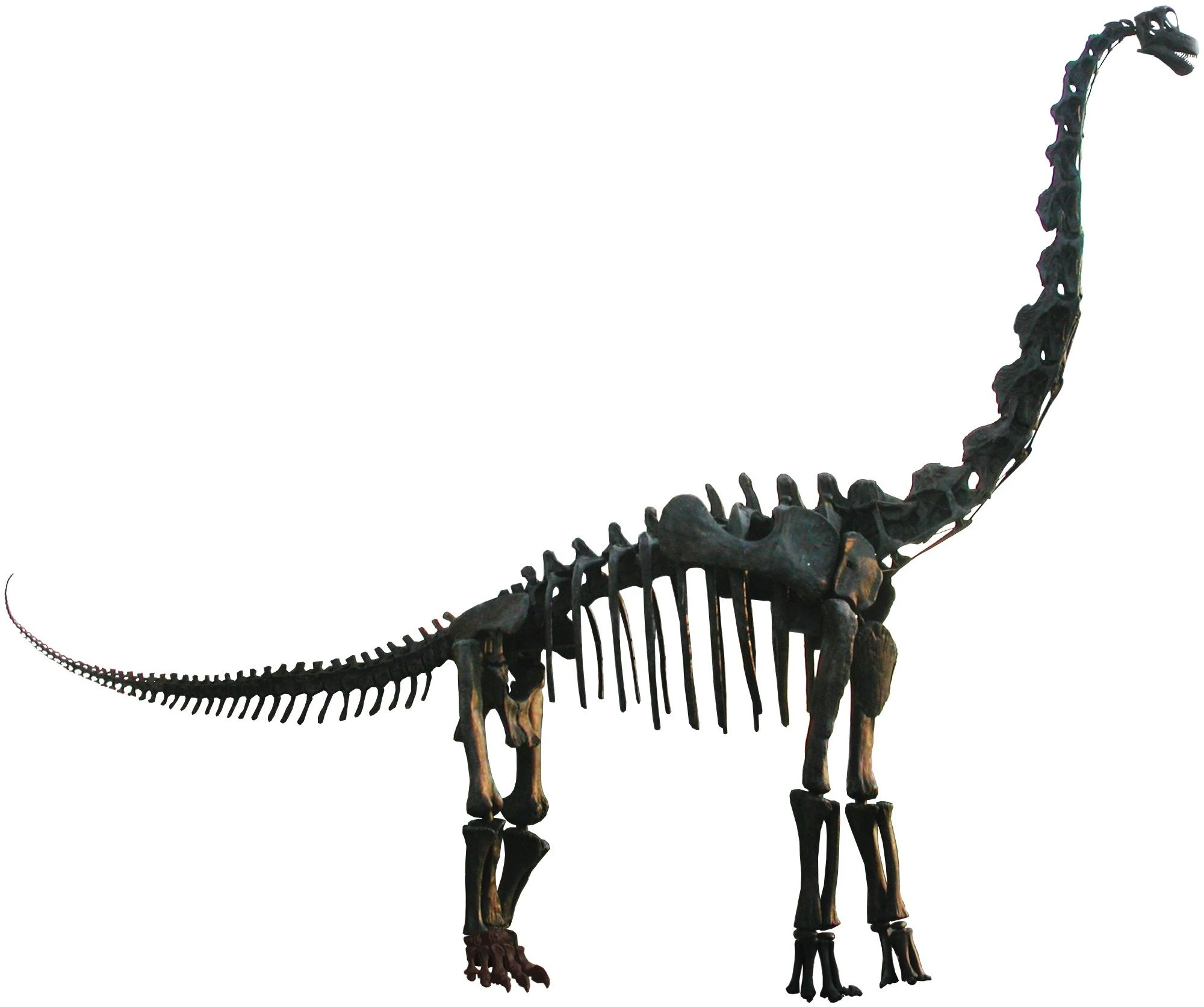

The build — a giant that rises to the front
The quickest way to recognise Brachiosaurus is its posture. In most sauropods the front and back legs are similar in length and the back is roughly level; in this animal the front legs are longer, so the shoulders stand higher than the hips and the back slopes up into the neck. With the long neck on top, its head could reach higher than that of any other four-legged dinosaur. The related Giraffatitan skeleton in Berlin stands about 13 metres tall — about the height of a four-storey building.
For its bulk, the head was small, and the teeth were simple tools for cropping leaves: the chewing was done not in the mouth but in the gut, as the next section explains. Four column-straight legs carried tens of tonnes.
How it ate — swallowed whole, fermented in the gut
The long front legs and long neck are equipment for feeding high up. Where its contemporary Brontosaurus fed on low vegetation, Brachiosaurus reached far higher, into conifers and tree ferns.
Its digestion was the unusual part. Brachiosaurus could not chew, so it swallowed leaves whole and broke them down by hindgut fermentation — microbes in the rear of the gut doing the work, the same system horses, elephants and rabbits use today. An animal of this size had to process an enormous amount of foliage every day, and skipping chewing to ferment at length would have saved time. The upward-tilted posture is both this dinosaur's easiest identification mark and the evidence of how it divided feeding heights with its neighbours.
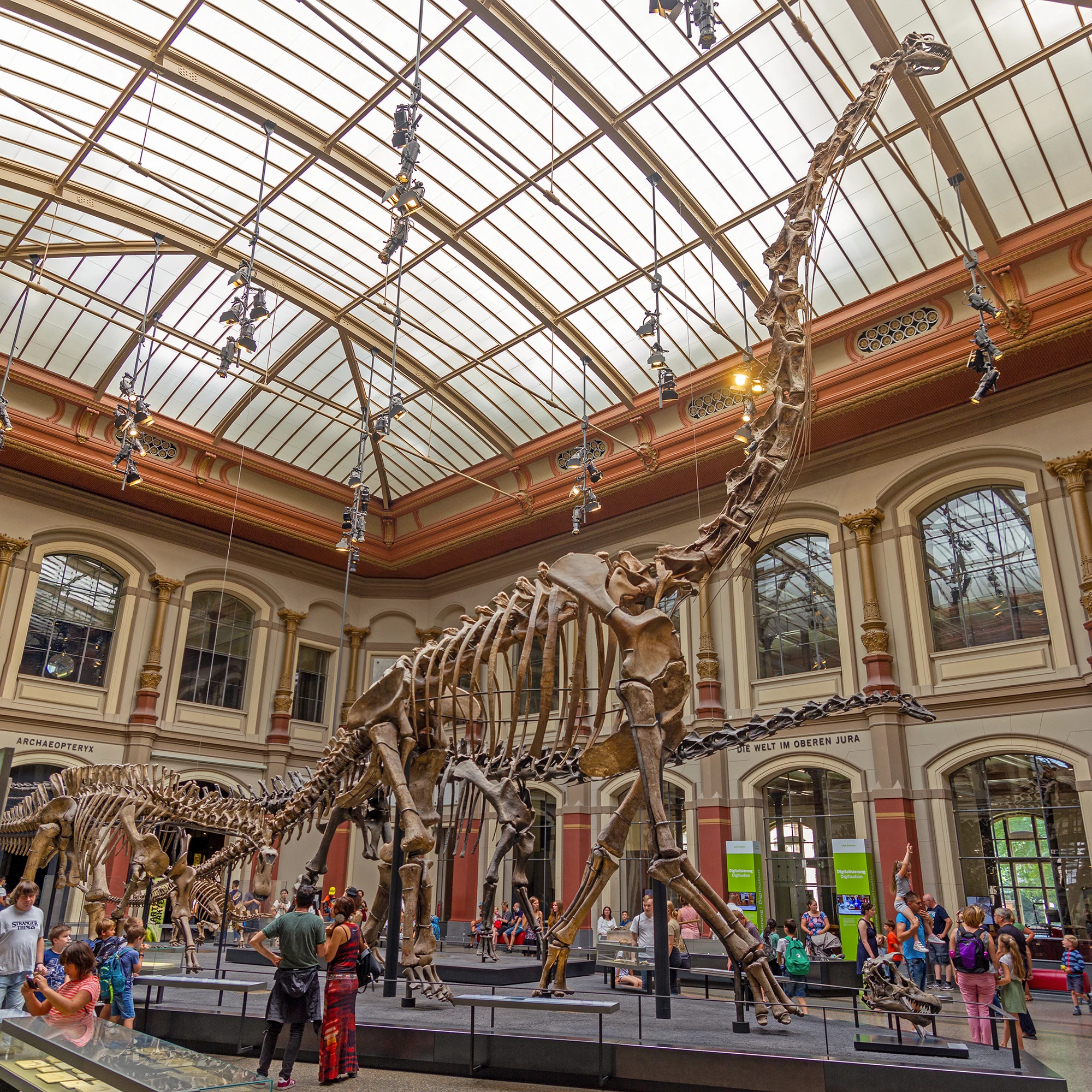

Size comparisons — two buses, and a bigger dinosaur still
At about 22 metres, Brachiosaurus is roughly two city buses end to end. At 30–47 tonnes, it weighs as much as five to eight African elephants. Its head reached about 13 metres up, which is what its high feeding was built on.
It was not, however, the largest dinosaur. Argentinosaurus, found in Argentina, is estimated at about 35 metres long and 80,000 kg — far bigger. And since the Brachiosaurus type specimen may not have been fully grown, adults may have been slightly larger than current estimates. Even so, they probably never approached Argentinosaurus.
The fact that no complete skeleton exists
No complete Brachiosaurus skeleton has ever been found. The full-body mounts in museums are reconstructions that fill the gaps from Giraffatitan, a close relative found in Africa. Giraffatitan was once classified as a species of Brachiosaurus, but scientists now treat the two as distinct. So the skeleton in the photographs is not 'the bones of Brachiosaurus itself' but a restoration built from its fossils plus a relative's record — worth knowing before you look. That the Berlin Giraffatitan is counted the tallest mounted dinosaur skeleton in the world shows how much this genus's image rests on its relative.
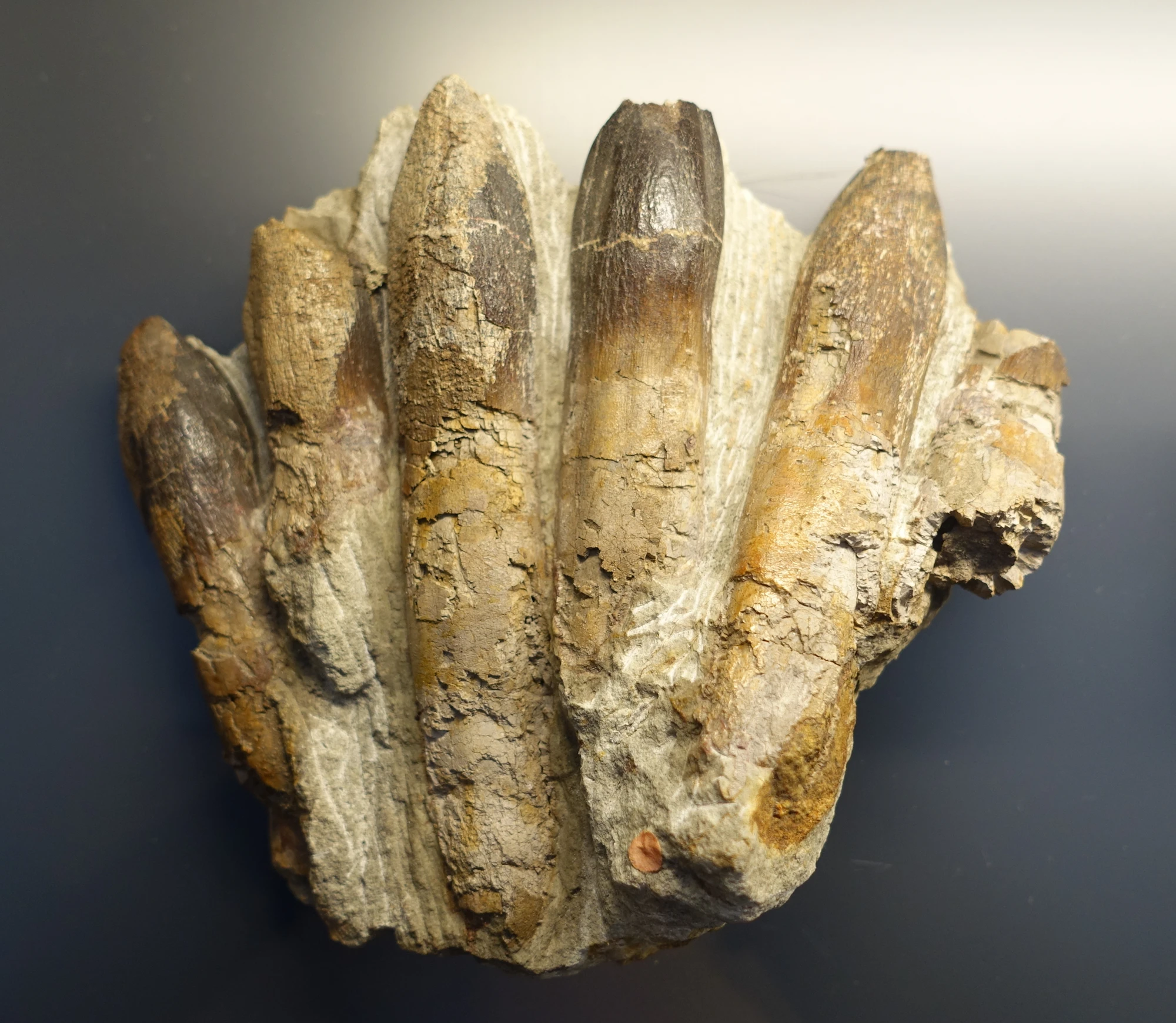

Discovery — first taken for a Brontosaurus
The first find came in 1900 in Colorado, USA. Elmer S Riggs, a scientist from Chicago, at first thought he had found a Brontosaurus, but soon realised this dinosaur must have been much bigger. He named it Brachiosaurus in 1903, and at the time it was the largest dinosaur ever discovered. The geography is part of the record: Brachiosaurus itself is American, while the Giraffatitan that anchors its reconstructions was found in Tanzania — the familiar image of this dinosaur is a composite of two discoveries on different continents.
Where to see one in Korea
The special exhibition "Footprints of Giants: Sauropod Dinosaurs" at the Jinju Pterosaur Tracks Museum (19 November 2026 – 28 February 2027) presents a life-size digital restoration of a Brachiosaurus skeleton in its lobby. It is a limited-run exhibition rather than a permanent display, so this is effectively the only chance to meet this species in Korea for now. Reading the reconstruction story above first will tell you what the display was built from.
Sources
- Natural History Museum, London — Dino Directory, "Brachiosaurus" — nhm.ac.uk
- Jinju Pterosaur Tracks Museum special exhibition announcement (Jinju City).