Velociraptor is remembered far larger than it really was, thanks to the films. In reality it was about the size of a large turkey — roughly 2 metres long including the tail, and around 15 kg. Alongside the basic record, this guide adds how it hunted, the evidence for feathers, and the famous "Fighting Dinosaurs" fossil that froze one mid-battle with a Protoceratops.
The record at a glance
| Scientific name | Velociraptor mongoliensis. Named by Henry Fairfield Osborn in 1924. |
|---|---|
| Name meaning | 'Swift plunderer' — the quick robber. |
| Era | Late Cretaceous, about 74–70 million years ago. |
| Length | Estimated at about 2 metres, tail included. |
| Weight | Around 15 kg. About half the bulk of the human-sized film version. |
| Diet | Carnivorous — a hunter with sharp teeth and a large sickle-shaped claw on each hind foot. |
| Found in | Late Cretaceous rocks of Mongolia. |
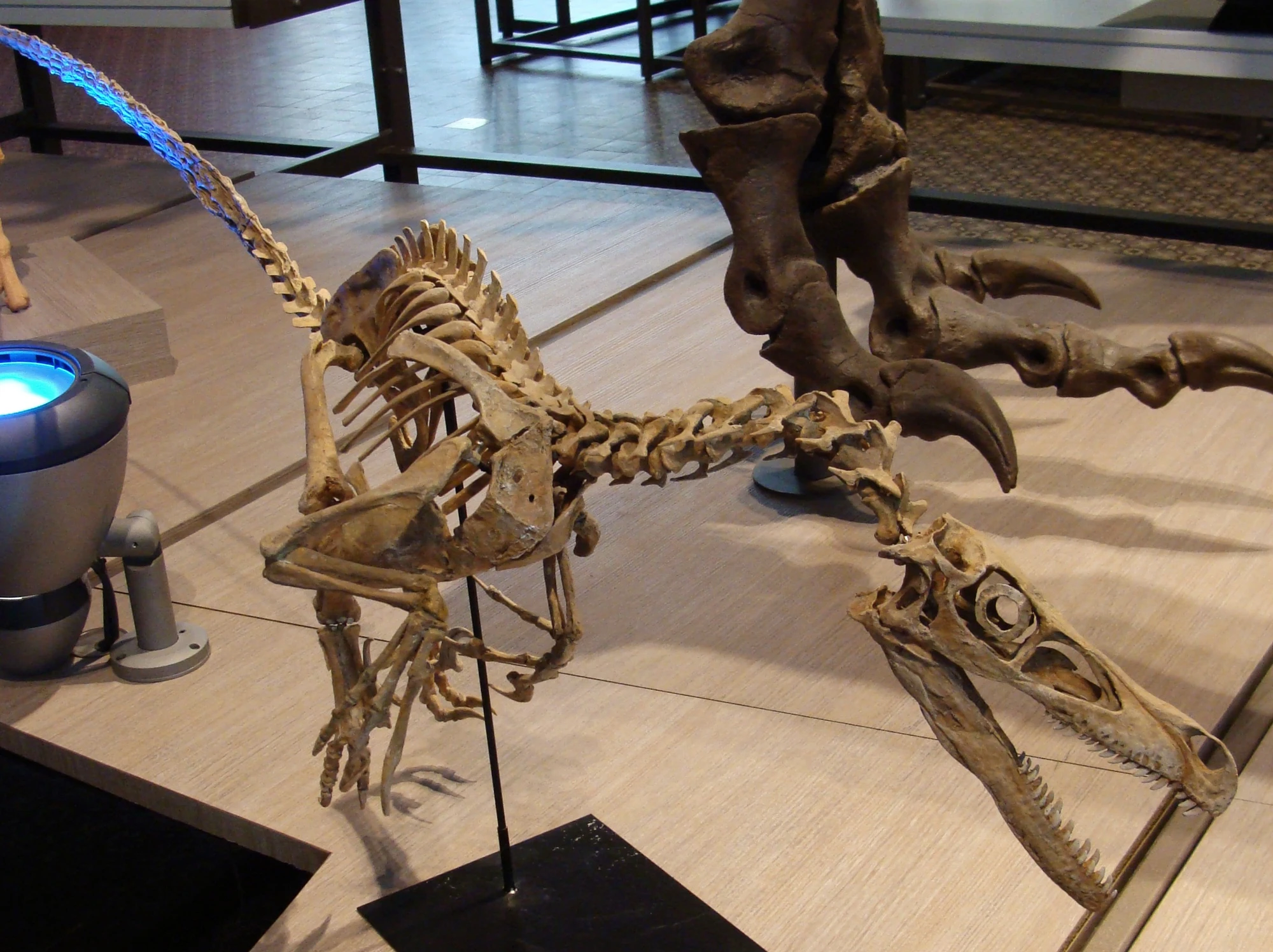

The build — small, but a hunter's structure
The skull, up to about 23 cm long, was long and low, with the snout tip curving slightly upward — a mark of this genus. The jaws carried rows of sharp, pointed teeth. Behind the body, the long tail was stiffened by tendons, likely working as a counterbalance when running and turning.
Its most famous part is the large sickle-shaped claw on the second toe of each hind foot, carried raised off the ground and brought down on prey. The current reading is that it was used to tackle and restrain prey rather than to slash. The arms were short but had fingers and claws, giving this small hunter a good grip.
Size comparisons — one large turkey
The 1.5–2.07 metres of length sounds bigger than it is, because nearly half of it is tail. The hips stood only about 0.5 metres high — around an adult's knee — and the weight, roughly 14–20 kg, matches a large turkey or a medium-sized dog. Where the film raptors met people eye to eye, a real Velociraptor looked up from thigh height. It was a small hunter, and that is the starting point for understanding it.
The films versus the record
The raptors of Jurassic Park were made about twice the size of the real Velociraptor and were closely modelled on its relative Deinonychus. Soon after the first film, a relative of about that size, Utahraptor, really was discovered — but Velociraptor itself stayed small. The scaly armour of the films is also a film invention; the fossils point to feathers, as the next section explains.
It probably had feathers
The Natural History Museum in London summarises this species as having had a fine feather-like covering. One line of evidence is the row of bumps reported on the forearm bone, read as the attachment points of feathers; in 2007 a specimen was reported with quill knobs on its ulna. It could not fly, so the feathers were likely for warmth or display. The picture that results looks nothing like the scaly film version.
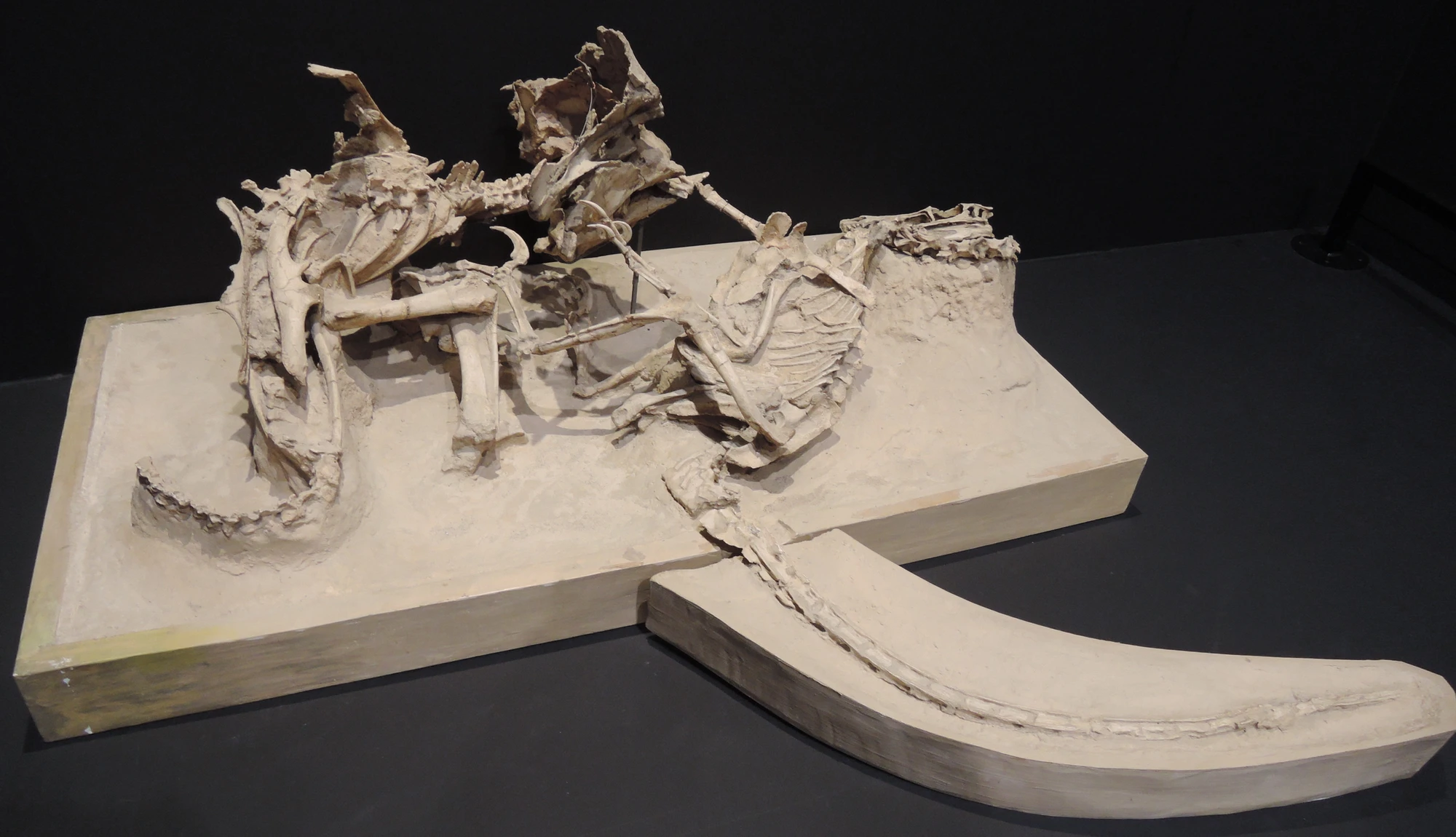

The fossil evidence — frozen mid-fight
The fossil that made this genus famous is the "Fighting Dinosaurs", found in 1971 at Tugriken Shireh in Mongolia by a Polish-Mongolian expedition. One Velociraptor grips the Protoceratops around the neck with its arms and aims its sickle claw, while the Protoceratops bites down on that arm — both preserved in the middle of the fight. The pair were apparently buried in sand as they fought, and the specimen is almost the only direct scene of how this hunter actually attacked. It is regarded as a national treasure of Mongolia, and in 2000 it was loaned to the American Museum of Natural History in New York for a temporary exhibition.
Discovery — 1923, at the Flaming Cliffs
The first find came on 11 August 1923 at the Flaming Cliffs (Bayanzag) in Mongolia's Gobi Desert. Peter Kaisen, of the American Museum of Natural History's Central Asiatic Expedition, found a crushed but complete skull together with a claw. The next year Osborn made that specimen the type of his new genus Velociraptor, a name built from the Latin velox (swift) and raptor (robber or plunderer). During the Cold War, Polish and Soviet expeditions added more specimens; since the 1990s, joint Mongolian-American teams have added more still. With over a dozen skeletons described, it is one of the best-studied small dinosaurs.
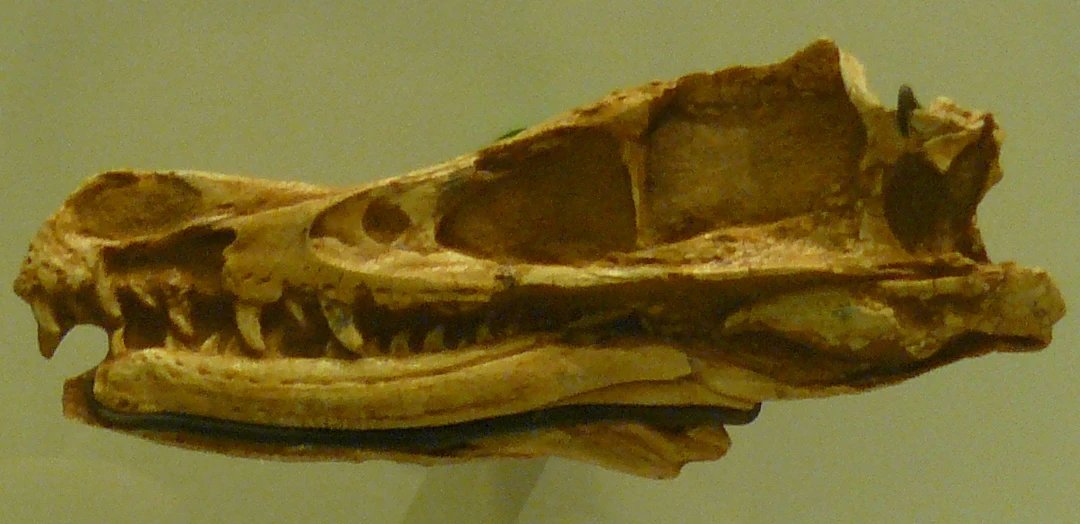

Where to see one in Korea
The real fossils of this species come from Mongolia and China, and no Korean museum in the range checked shows one on permanent display. Instead, the fossil track sites around Goseong and Jinju in South Gyeongsang Province let you walk among traces left by dinosaurs of the same age. A related note is kept in the DINO BOX fossil-site notes.
Sources
- Natural History Museum, London — Dino Directory, "Velociraptor" — nhm.ac.uk
- Wikipedia, "Velociraptor" — discovery history and the Fighting Dinosaurs specimen number cross-checked — en.wikipedia.org