Stegosaurus is the dinosaur recognised by the two rows of plates along its back. The 'roof' in its name survives from the first interpretation, when the plates were thought to lie overlapping like roof tiles. Alongside the basic record, this guide adds the competing explanations for the plates, the tail spikes it actually fought with, and the story of "Sophie", the near-complete skeleton in London.
The record at a glance
| Scientific name | Stegosaurus armatus is the type species. Named by Othniel Charles Marsh in 1877. |
|---|---|
| Name meaning | 'Roof lizard' — the name preserves the first reading of the plates as a roof-like covering. |
| Era | Late Jurassic, about 152–145 million years ago — the same world as Brachiosaurus. |
| Length | Estimated at about 9 metres. |
| Weight | About 3–5 tonnes; estimates vary, so a range is given. |
| Diet | Herbivorous. It fed on low plants; its head was small and its brain about the size of a plum. |
| Found in | Late Jurassic rocks of the USA. |

The build — a large body, a small head
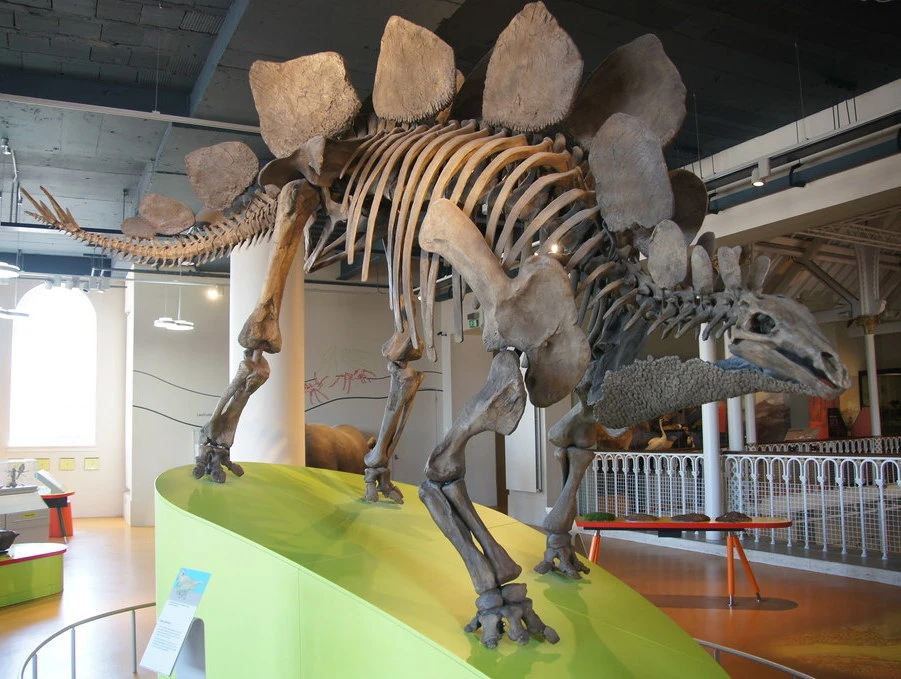
The Stegosaurus body is a study in contrasts. Behind a body some 9 metres long stood two rows of plates and, at the tail's end, four spikes; at the other end sat a head small for the body, with a brain around the size of a plum. The mouth was built for cropping low vegetation, and the head could not be raised high, so its food was the plants near the ground.
The legs were uneven — short front legs, longer back legs — so the hips stood higher than the shoulders. It was a slow-moving, large plant-eater, and its defence was not flight but the tail, as the fighting section below explains.
The plates were in the skin, not on the skeleton
The plates along the back were embedded in the skin, not attached to the skeleton — which is why fossil plates are usually found separated from the body. Marsh himself first concluded that the plates lay flat on the back; a specimen preserved in mud, holding the plates in place, showed him they stood vertically, alternating on either side of the spine. That change of mind by the very scientist who named the genus is a famous episode in its research history.
What the plates were for is still hypothesis
What the plates were used for is not settled. They may have warned off predators, or allowed members of the same species to recognise each other. Another suggestion is temperature control: there are tiny grooves in the plate surfaces, possibly where blood vessels ran, and the amount of blood passing through them would have set how much heat was exchanged. None of these is written here as settled fact.

Defence — four spikes on the tail
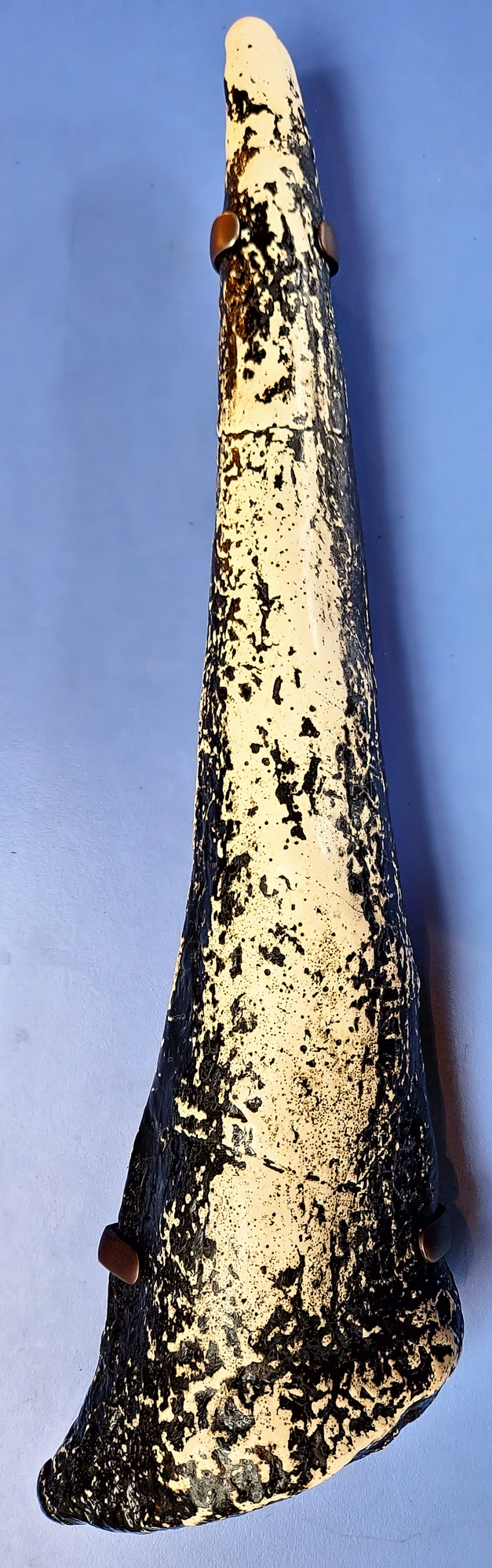
There is little disagreement that the four spikes at the end of the tail were a weapon, swung at predators such as Allosaurus and Ceratosaurus. The spikes carry the nickname "thagomizer" — a joke name from a cartoon that scientists adopted as-is. Slow and small-brained as it was, this plant-eater was not safe to approach from behind. If the plates were for display and recognition, the tail was the actual weapon, and the two divide the work between them.

Size comparisons — bus-length, with a plum-sized brain
At about 9 metres, Stegosaurus is a little shorter than a city bus, and at 3–5 tonnes it weighs about as much as one African elephant. The sharpest contrast is the brain: an animal the length of a bus ran on a brain the size of a plum. A small brain does not by itself mean a dull animal, though — steady low browsing, plates for display, and a spiked tail for predators fit the build of its body very well.
Discovery and research — London's "Sophie"
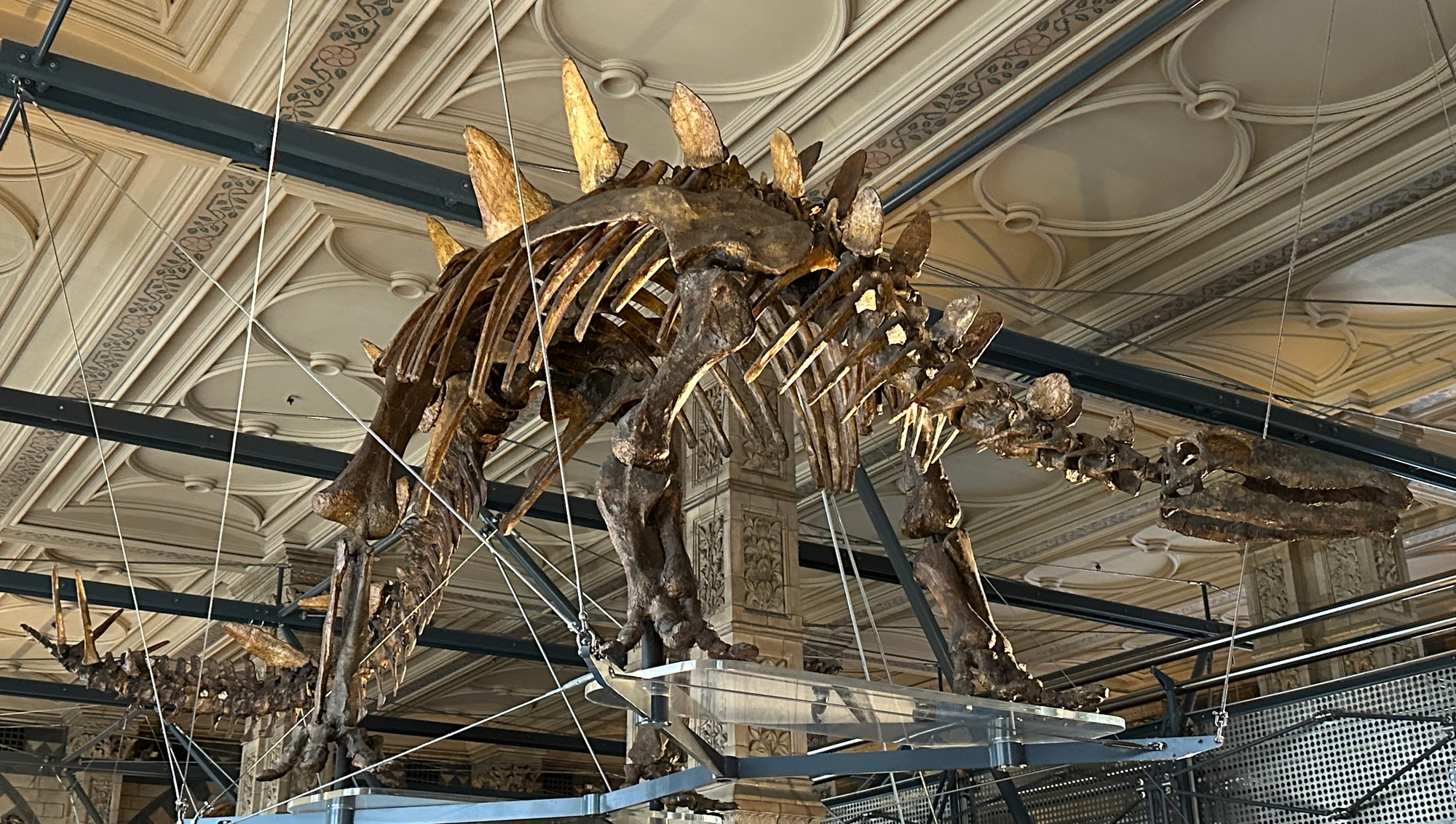
The specimen no account of this genus can skip is "Sophie" at the Natural History Museum in London: a near-complete skeleton of Stegosaurus stenops, on display in the museum's Earth Hall since December 2014. For a genus whose plates scatter in the skin, a near-complete skeleton is rare, and Sophie became the reference for reading anew how this dinosaur walked, ate and behaved. Marsh named the genus in 1877, but the closest approach to its complete form came with this specimen.
Where to see one in Korea
A Stegosaurus skeleton is on display in the central hall of the Geological Museum at the Korea Institute of Geoscience and Mineral Resources in Daejeon — it is one of the species the museum's official page itself describes as a skeleton. Admission is free and opening hours are 10:00–17:00 (checked on the official page in October 2026). The same hall holds a Tyrannosaurus, so a Jurassic plant-eater and a Cretaceous predator can be compared in one room.
Sources
- Natural History Museum, London — Dino Directory, "Stegosaurus" — nhm.ac.uk
- Geological Museum (KIGAM), central hall guide — kigam.re.kr