Volume 3 of Minumsa's World Literature series is William Shakespeare's Hamlet. It is widely known as the story of a Danish prince who learns the truth about his father's murder from a ghost, swears revenge, and then keeps not drawing his sword. After reading this, you will be able to tell apart the scenes in which Hamlet stops and the scenes in which he moves without hesitation, and to read the play alongside two other sons who stand where he stands.
Translated by Choi Jong-chul from the Arden text
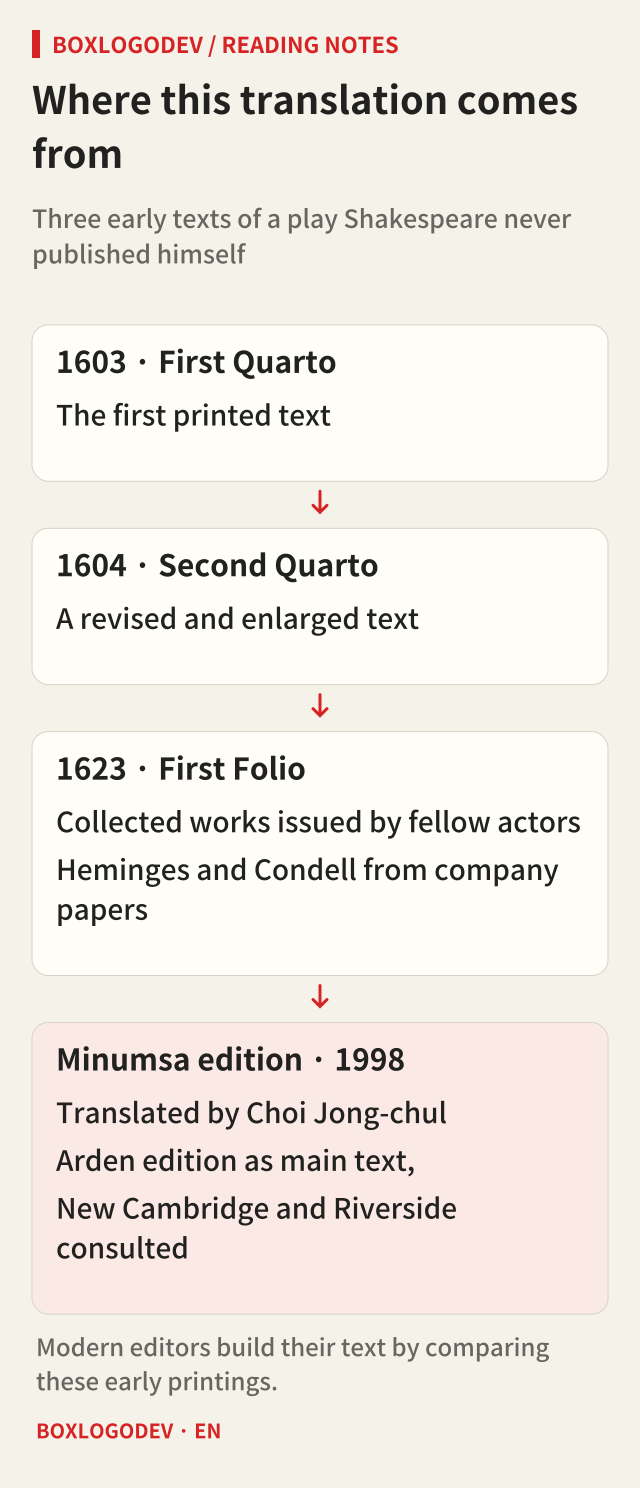
Minumsa's Hamlet was translated by Professor Choi Jong-chul and published in 1998. Its 248 pages hold a list of characters, the text of Acts 1 to 5, the translator's commentary and a chronology of the author's life. According to the publisher's description, the translator used the Arden Shakespeare as his main text and also consulted the New Cambridge and Riverside editions.
Why the base text matters becomes clear from how the play came down to us. Shakespeare's plays belonged to his company, and Hamlet was not a book he published himself. Three early texts survive: the First Quarto of 1603; the Second Quarto of 1604, which revised and enlarged it; and the First Folio of 1623, compiled after Shakespeare's death by his fellow actors John Heminges and Henry Condell from material the company had kept. The three differ in length and wording, so modern editors settle a text by comparing them, and a translation in turn follows one of those editions.
The most famous line, “To be, or not to be,” appears in this translation as “있음이냐 없음이냐, 그것이 문제로다” — literally, “Being or not being, that is the question.” Where the familiar Korean rendering jungneunya saneunya (“to die or to live”) sounds like a choice between life and death, this version leans toward a question about existence itself. The passages quoted in the publisher's description are set in separate lines, as in the original. Reading the speeches line by line, aloud if possible, rather than running them together like prose, makes it easier to follow the play's rhythm.
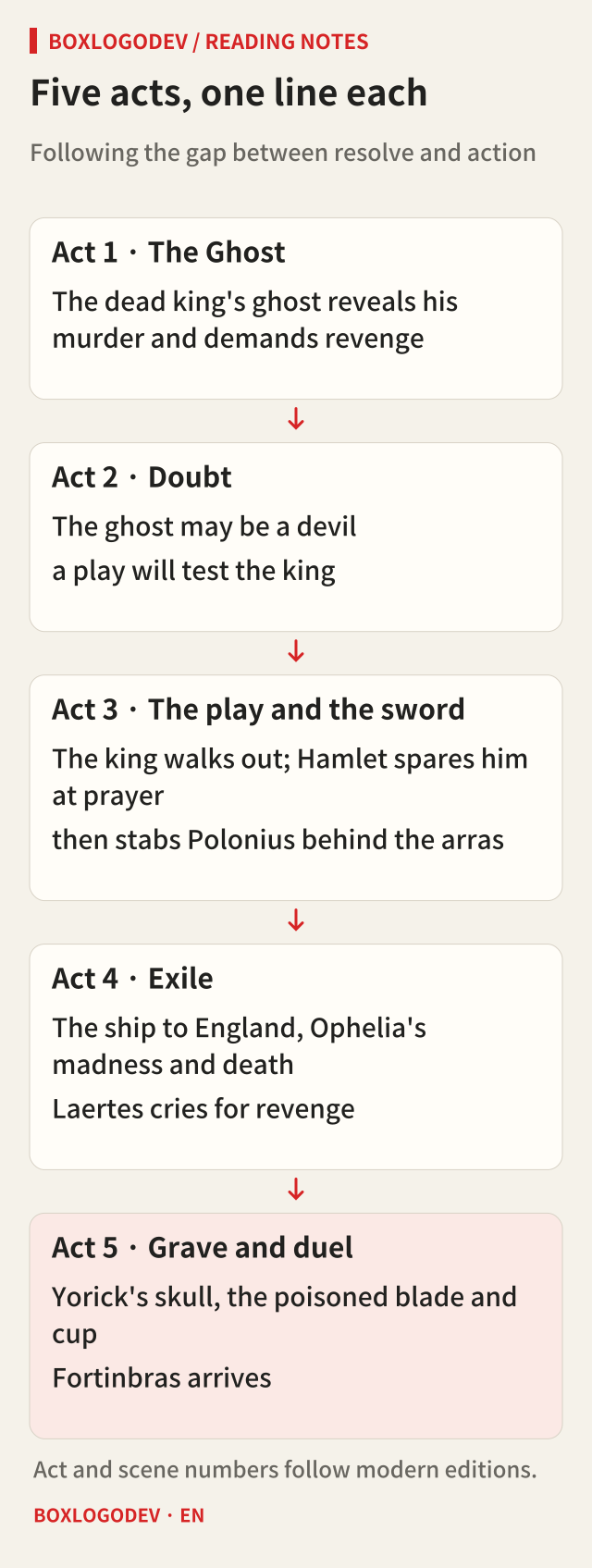
The five acts, one line at a time
In Act 1 the ghost of the dead king appears on the battlements of Elsinore. Less than two months after the king's death, Queen Gertrude married his brother Claudius, who is now king. The ghost tells Hamlet that while he slept in his orchard his brother poured poison into his ear, and commands him to take revenge. Hamlet makes his friends swear in advance that, however strangely he may behave from now on, they will give no sign of knowing why.
In Act 2 the counsellor Polonius believes Hamlet has gone mad for love of his daughter Ophelia, and the king summons Hamlet's old friends Rosencrantz and Guildenstern to find out what is on his mind. When a company of travelling players arrives, Hamlet wonders whether the ghost he saw might be a devil, and decides to stage a play resembling his father's murder and watch the king's reaction.
Act 3 is the heart of the play. When The Murder of Gonzago reaches the poisoning, the king rises and leaves. Soon after, Hamlet finds the king praying alone and puts up his sword; then, in his mother's room, he thrusts through the arras at a sound behind it and kills Polonius. In Act 4 the king ships Hamlet off to England with a letter ordering his death, but Hamlet meets pirates at sea and returns to Denmark. Meanwhile Ophelia loses her mind and drowns, and her brother Laertes, back from France, cries out for revenge for his father. In Act 5 Hamlet looks at the skull of Yorick, the old court jester, dug up by a gravedigger, and soon after comes upon Ophelia's funeral. In the final duel the queen drinks from the poisoned cup, and both Laertes and Hamlet are wounded by the poisoned blade. Only then does Hamlet stab the king and make him drink what is left.
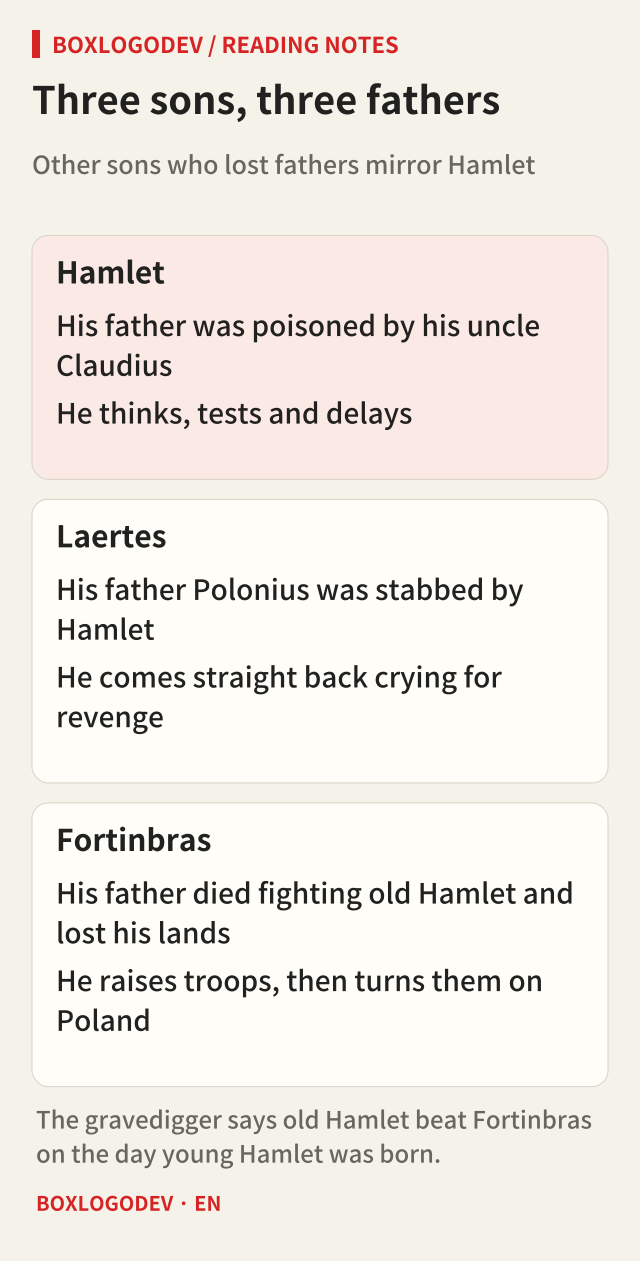
Three sons give different answers to one question
Hamlet is not the only son in the play who has lost a father. Laertes's father Polonius dies on Hamlet's sword. Laertes comes straight back when he hears, bursts into the palace at the head of a crowd, and ends up joining the king's plot and poisoning the tip of his own blade. The father of Fortinbras, prince of Norway, died in single combat with old King Hamlet and, under their agreement, forfeited his lands. Early in the play Fortinbras gathers troops to win those lands back, but after a rebuke from his uncle, the king of Norway, he turns the army against Poland instead.
Set side by side, the three show that Hamlet's hesitation is not only a matter of character but part of the play's design. Laertes rushes in without thinking and becomes a tool of someone else's scheme; Fortinbras acts even when the cause is small. Hamlet, between them, keeps asking questions. The two threads meet once, in the graveyard scene of Act 5: the gravedigger says he took up his trade on the day old Hamlet overcame Fortinbras, which was the very day young Hamlet was born. And at the end of the play the dying Hamlet gives Fortinbras his voice as the next king.
Scenes where he stops, scenes where he rushes
Why Hamlet delays is an old question, but it helps to notice first that each time he stops, he gives his own reason in the text. At the end of Act 2 he says the ghost could be a devil exploiting his grief, that he needs firmer grounds, and so he prepares the play. Here delay is also a way of checking.
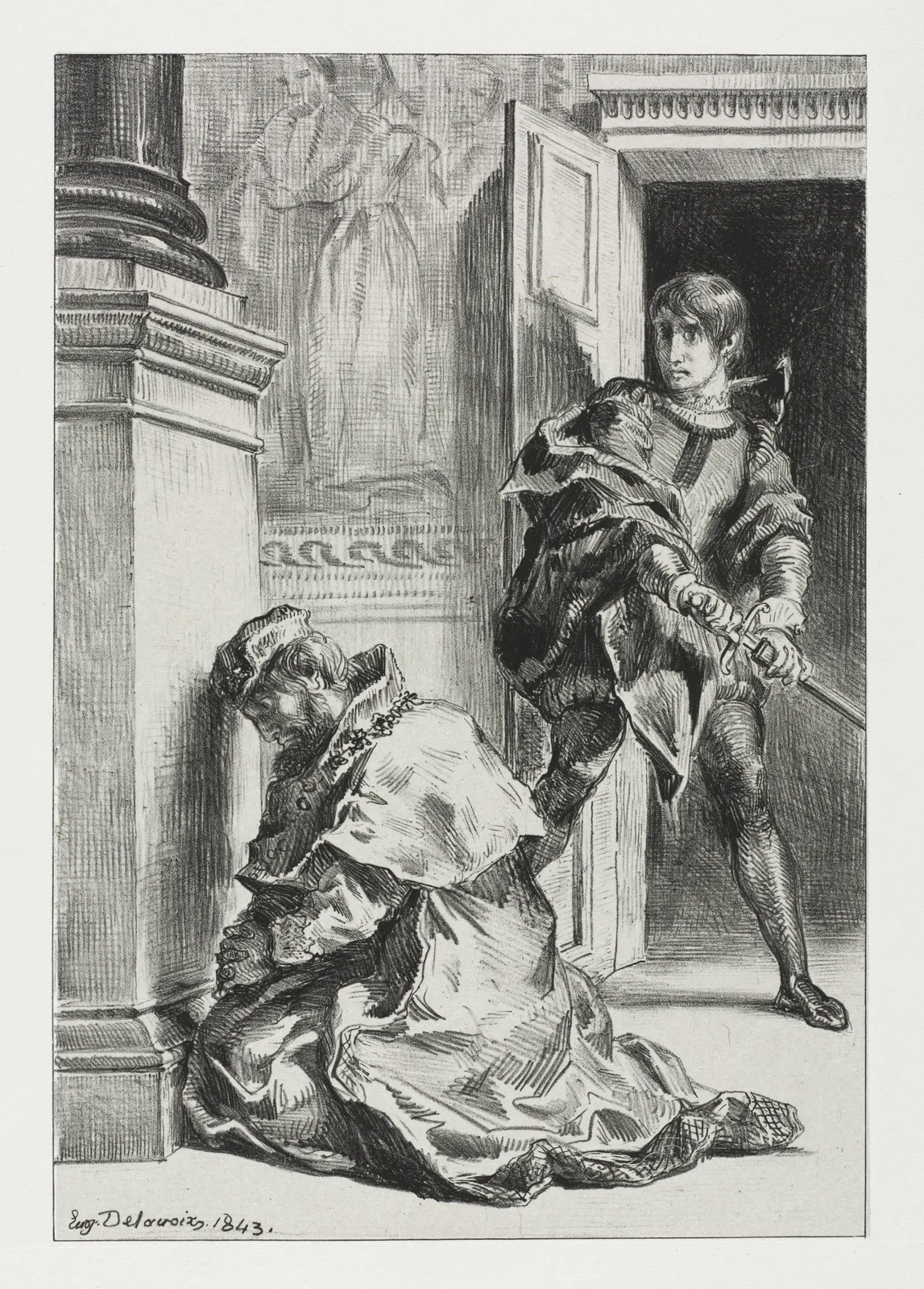
Act 3, Scene 3 is clearer still. Now convinced by the play, Hamlet stands behind the king, who is kneeling in prayer. Having just said he could do it now, he puts up his sword: killed at prayer, his enemy would go to heaven. He will wait until the king is drunk asleep, or at some act with no trace of salvation in it. Yet once Hamlet has gone, the king admits that his words fly up while his thoughts remain below — his prayer never reached heaven. The reason Hamlet stopped did not actually hold.
And in the very next scene Hamlet does not hesitate at all. When something stirs behind the arras in his mother's room, he cries “a rat” and stabs without looking. The most cautious man in the play commits its most rash killing, and the two scenes stand back to back. The contrast between them is the key to reading Act 3.
What to mark as you read
First, the two faces of madness. In Act 1 Hamlet warns that he may put on an act of madness, and Polonius remarks in an aside that there is method in his nonsense. Ophelia's madness has no such calculation behind it. Compare how the same word, mad, works for the two characters.
Second, the play within the play. Hamlet coaches the actors not to overdo their lines and uses the performance as a trap for the king's conscience. If you mark who is watching whom and who is acting, the thread runs all the way to Polonius hiding behind the arras.
Third, Hamlet in Act 5, Scene 2. Before the duel he admits a bad feeling about his heart, yet he says there is a special providence even in the fall of a sparrow, and adds that the readiness is all. The man who planned and tested in earlier acts lets go of planning here. Whether this is resignation or insight is for the reader to decide. Minumsa's description also notes that in Act 5, Scene 2 Hamlet seems to move beyond a world split into being and not being, good and evil, so it is worth comparing that reading with the translator's commentary after you finish the text.
If you try just one thing
For each act, write two lines side by side: the moment Hamlet says what he will do, and the moment he actually moves. Between the vow in Act 1 and the final blow in Act 5, the gap is narrowest, surprisingly, when he kills Polonius, and widest before the praying king. As you fill in the two lines, Hamlet reads less like a story of delayed revenge and more like a play that shows, one after another, the moments when thought and action fall out of step.
Add your perspective.
Share a question, another approach, or something you have tried.
Checking sign-in…
Loading comments…