In Father Goriot, Goriot moves up twice in his boarding house. To modern ears that sounds like rising in the world, but in this house it is the reverse. The higher the room the cheaper it is, so going up means growing poorer. This guide reads Balzac's novel, number 18 in Minumsa's World Literature series in Park Young-keun's Korean translation, by way of those stairs. After reading it you will be able to work out Goriot's decline from the figures printed in the novel, and to see why Rastignac, on the same floor, goes the opposite way. The ending is discussed.
What kind of book is it?
By the publisher's listing, the Minumsa edition came out on 15 February 1999 at 486 pages, in four parts (a boarding house, entry into society, Trompe-la-Mort, a father's death), with Park's commentary and a chronology of the author's life. One library record (CiNii), describing the 42nd printing of 2015, gives 419 pages, so your copy may differ. The original by Honoré de Balzac (1799–1850) ran in a magazine from December 1834 to February 1835 and came out as a book in March 1835. The story begins at the end of November 1819. The publisher, too, presents the contrast between an old bourgeois's decline and a young nobleman's urge to rise as the novel's frame.
The figures and quotations here were checked against the French text on Project Gutenberg and Ellen Marriage's English translation. The wording of the Minumsa edition was not compared, so its spellings and its way of counting floors may differ.
A house where the price falls as you climb
The novel sets out Mme Vauquer's boarding house floor by floor. The ground floor has the parlor and dining room, and the best rooms are on the first floor. Mme Couture and Victorine pay 1,800 francs a year between them, and the owner lives on this floor too. Poiret and Vautrin on the second floor pay 72 francs a month; Mlle Michonneau, Goriot and the students on the third pay 45 francs a month. In the garrets above sleep the servant and the cook. The novel says Mme Vauquer measures out her respect exactly to what each lodger pays. A floor means money, and money means treatment.
"First floor" here is the French premier étage, one flight above the ground. Counting the ground floor as one, as Koreans and Americans do, Goriot climbs from 2 to 3 to 4. The novel does not stop to explain why higher rooms are cheaper. It reads as taking for granted that a room up more stairs is the lesser room.
READING NOTES
The Maison Vauquer, November 1819
The higher the room, the lower the price
Garrets under the roof
- The servant Christophe and the cook Sylvie
Third floor · 45 francs a month
- Mlle Michonneau, Father Goriot, Rastignac
Second floor · 72 francs a month
- Poiret and Vautrin
First floor · 1,800 francs a year for two
- Mme Couture and Victorine; the owner, Mme Vauquer
Ground floor
- Parlor and dining room
French numbering · the first floor is one flight above the ground
Working out the two moves
Goriot closes his business and enters the house in 1813, at about sixty-nine. In the first-floor rooms Mme Couture now uses, he pays 1,200 francs a year. Toward the end of the second year he moves to the second floor and pays 900, going without a fire in winter, and from then on the landlady calls him Father Goriot. Toward the end of the third year he goes up to the third floor and pays 45 francs a month, giving up snuff, his hairdresser and hair powder.
On the same basis: 1,200÷12 = 100 francs a month; 900÷12 = 75 francs a month; 45×12 = 540 francs a year. And 540÷1,200 = 45 percent, so his board has fallen below half of where it began. One thing does not quite match. The second-floor price at the time of the story, 72 francs a month, is 864 a year, a little off the 900 Goriot paid. The novel does not explain the difference.
READING NOTES
What Goriot paid
What changed with each price
1813 · First floor
- 1,200 francs a year (100 a month)
- People call him M. Goriot, respectfully
End of year two · Second floor
- 900 francs a year (75 a month)
- No fire in winter; he becomes Father Goriot
End of year three · Third floor
- 45 francs a month (540 a year)
- No snuff, hairdresser or powder
540÷1,200 = 45% · figures from the novel, conversions by this guide
The money went to his two daughters. In his days as a vermicelli maker, Goriot is said to have had an income of more than 60,000 livres a year (Marriage's English says francs) and to have spent not even 1,200 francs of it on himself. Treating livres and francs as about equal, that is under 2 percent. Mme de Beauséant says that, by report, he gave each daughter 500,000 or 600,000 francs and kept only 8,000 to 10,000 livres a year for himself. Yet the lodgers suspect the splendid women who visit him of being mistresses rather than daughters. The higher he goes, the poorer he is and the more he is despised.
Rastignac, on the same third floor
The law student Rastignac lives on the same third floor. His family's land brings in about 3,000 francs a year, and 1,200 of it (40 percent) comes to him. When he asks for 1,200 francs more to enter society, his mother breaks up her jewels and his aunt, Mme de Marcillac, sells keepsakes to raise it, and his two sisters add 200 and 150, making 1,550. Vautrin offers him another road: he will find a bride with a dowry of a million francs in return for 20 percent, which is 200,000 francs. The bride is his fellow lodger Victorine, and the million comes only if her brother, her banker father's only son, dies. Vautrin means to have a friend call the brother out in a duel. What Vautrin means to do with the money is become a planter with slaves in the Southern States of America. Rastignac wavers but does not accept.
The figure 1,200 keeps coming back in this novel. What Goriot would not spend on himself, his first board, Rastignac's yearly allowance, the salary Vautrin gives a judge at thirty, and Goriot's last life annuity are all 1,200. Treating it as a measure of one person's modest year is this guide's reading; the novel does not say so.
By now Rastignac and Goriot's younger daughter, Delphine, Baronne de Nucingen, are in love. To be near her, Goriot pays for Rastignac's way out. He sells a perpetual annuity paying 1,350 livres a year, buys a life annuity of 1,200 francs a year for 15,000 francs, and with the rest pays for the new rooms on the Rue d'Artois. He calls it five thousand francs at most and lends it to Rastignac; later, in front of Anastasie, he says he needed twelve thousand francs to furnish rooms for Delphine. The rooms are up three floors in a new house, and Goriot means to live in a room on the fifth floor above them, paying 50 crowns a year and living on two francs a day. To the end he means to go higher.
But he never moves. To cover 1,000 francs toward the gown of his elder daughter, Anastasie, he sells his spoons, forks and buckles for 600 francs and signs over a year of his annuity to the moneylender Gobseck for 400 (600 + 400 = 1,000). Then he falls ill and dies on the third floor of the Vauquer house.
READING NOTES
The same floor, opposite directions
From winter 1819 to February 1820
Winter 1819 · Third-floor neighbors
- Both live in 45-franc rooms.
- Rastignac's family sends him 1,200 a year.
Rastignac · to the Rue d'Artois
- A furnished set of rooms up three floors.
- Goriot pays 'five thousand francs at most' up front.
Goriot · plans a fifth-floor room
- He means to live above those rooms
- on 50 crowns a year rent and two francs a day.
February 1820 · Still on the third floor
- He dies at the Vauquer house without moving.
- Rastignac stands on the height of Père-Lachaise.
Figures and events from the novel · 'opposite directions' is this guide's reading
The floor as a person's lot
This sense seems not to have been Balzac's alone. In 1836, a year after the novel, Grandville designed a print for Béranger's song "Les Cinq Étages" ("The Five Floors"). A woman born in a porter's lodge reaches a rich first floor, then sings "and up I go" each time her lot declines, and ends as an old sweeper in the garret on the fifth floor. Still, one song and one novel cannot establish a rule for all of Paris.
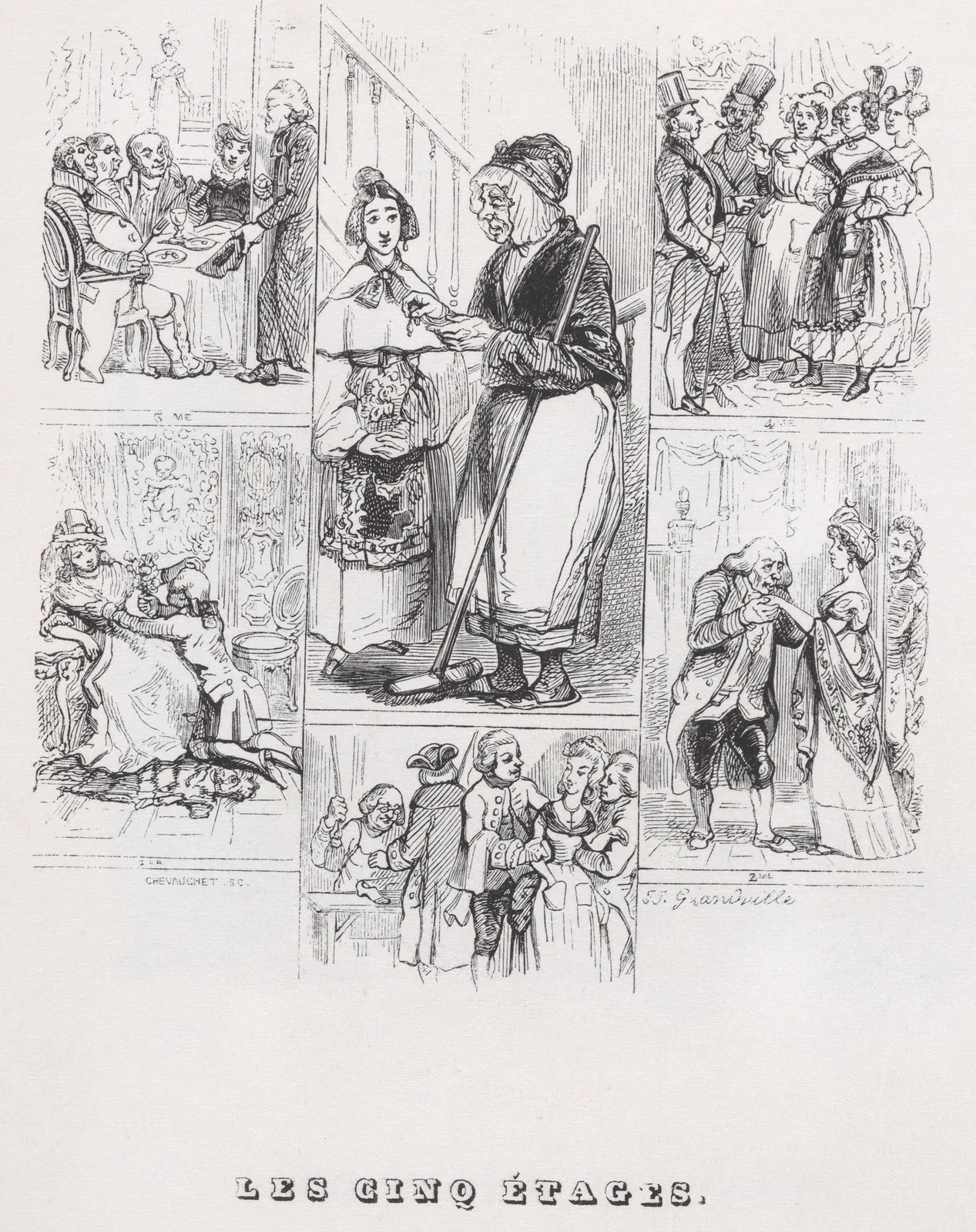
At the top of the cemetery
In the last scene, "up" takes on another meaning. Rastignac and the medical student Bianchon see to the funeral. The priests cost 70 francs, and with nothing left for the gravediggers Rastignac has to borrow twenty sous, one franc, from the servant (Marriage's English says five francs). The carriages of the two sons-in-law follow empty. He walks to the highest point of Père-Lachaise, looks down between the column of the Place Vendôme and the dome of the Invalides, and says "A nous deux maintenant!", roughly "now it is between the two of us" (Marriage: "Henceforth there is war between us"). Then he goes to dine with Delphine. Contrasting the "up" of poverty in the boarding house with the "up" of ambition on the cemetery hill is this guide's reading.
What to watch for
Keep a small table beside the book. Each time a sum appears, note who pays whom and how much. Check early on whether your translation counts floors the French way. This novel is regarded as the one in which Balzac began to use recurring characters in a structured way, so keep an eye on Rastignac and Vautrin, whom you can meet again in other books of La Comédie humaine.
It is easy to read this novel's sorrow as a father's love and nothing else. Follow Goriot's stairs and the figures beside them together. You will see how much his love cost, and on which floor the money ran out.
Add your perspective.
Share a question, another approach, or something you have tried.
Checking sign-in…
Loading comments…