In front of a seascape we look at the waves first. The white spray is the largest and brightest thing there, so that is natural. In Winslow Homer's late sea paintings, though, the pictures read differently if you look for one thing before the waves: the place where the viewer could stand, the nearest solid surface in the picture.
This note looks at four of Homer's oil paintings released by The Metropolitan Museum of Art in New York, in the same order each time. First find the rock under your feet, then see how high the horizon sits in the frame, and finally see what fills the space between the two. After these three steps you can check for yourself, in front of any other seascape, where the painter has placed you.
All four were painted between 1894 and 1896. According to The Met, Homer spent his last three decades at Prouts Neck, Maine, and made the coastal rocks and pounding surf he could see from his studio the main subject of his art. He was born in Boston in 1836 and died at Prouts Neck in 1910.
The rock under your feet: Northeaster
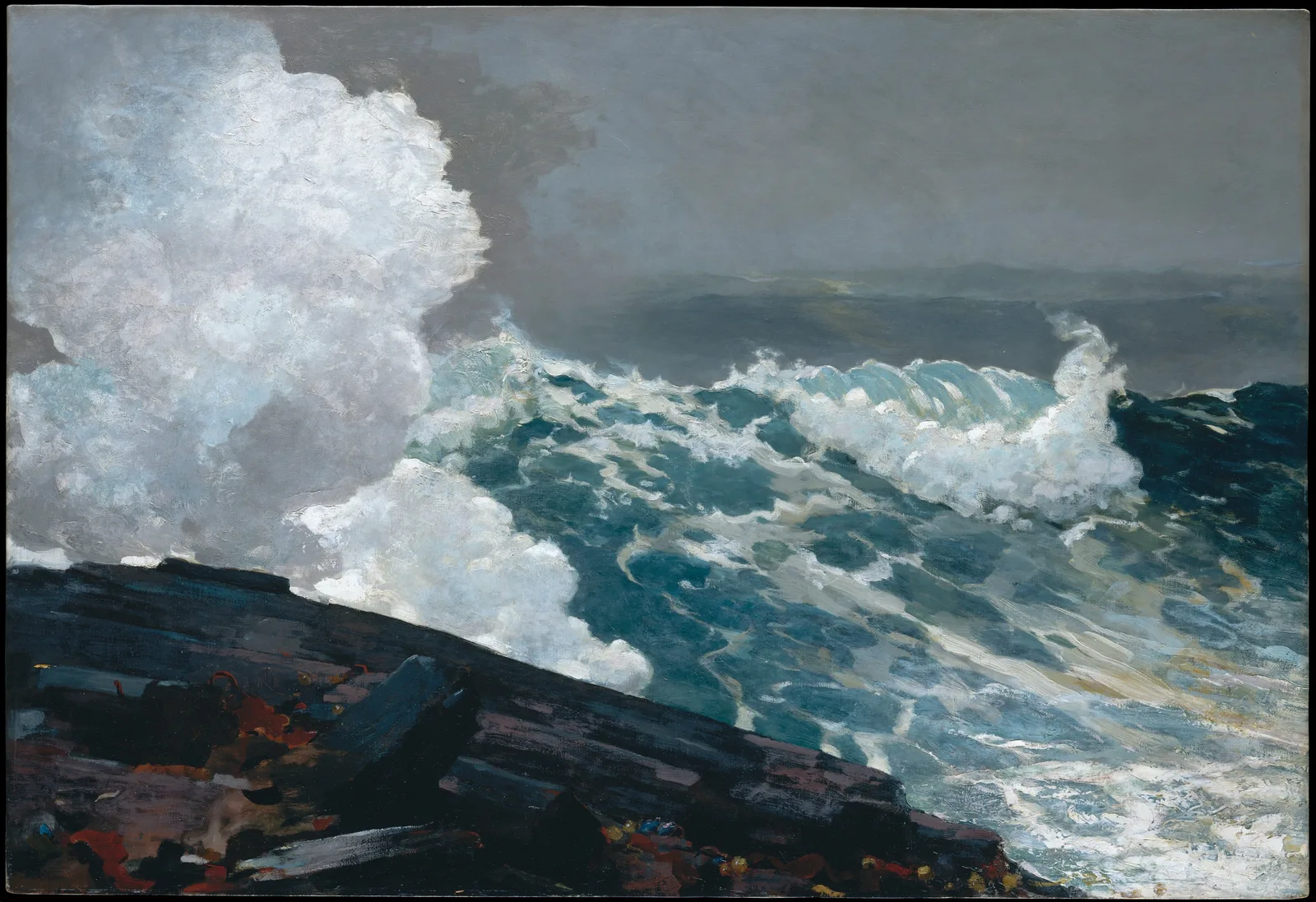
Northeaster is a large canvas, 127 cm wide. Along the bottom a dark ledge of rock runs diagonally downward from left to right. The rock is painted in near-black and violet with broad strokes laid along its grain, and small touches of orange and red are set between them. The ledge does not reach the right edge; it breaks off into white foam.
Just above the rock, the left third of the picture belongs to the spray. It rises high enough to touch the top edge and hides the sky and horizon behind it. The horizon shows only to the right of the spray, as a hazy band roughly a third of the way down. The sea is a surface of teal and dark green crossed by a net of white foam lines.
The Met's description records an important fact about this painting. When it was first exhibited in 1895, two figures crouched on the rocks at lower left; by 1900 Homer had painted them out and enlarged the spray. Today no one is on that ledge. The only person standing there is the one looking at the picture.
Between two rocks: Cannon Rock
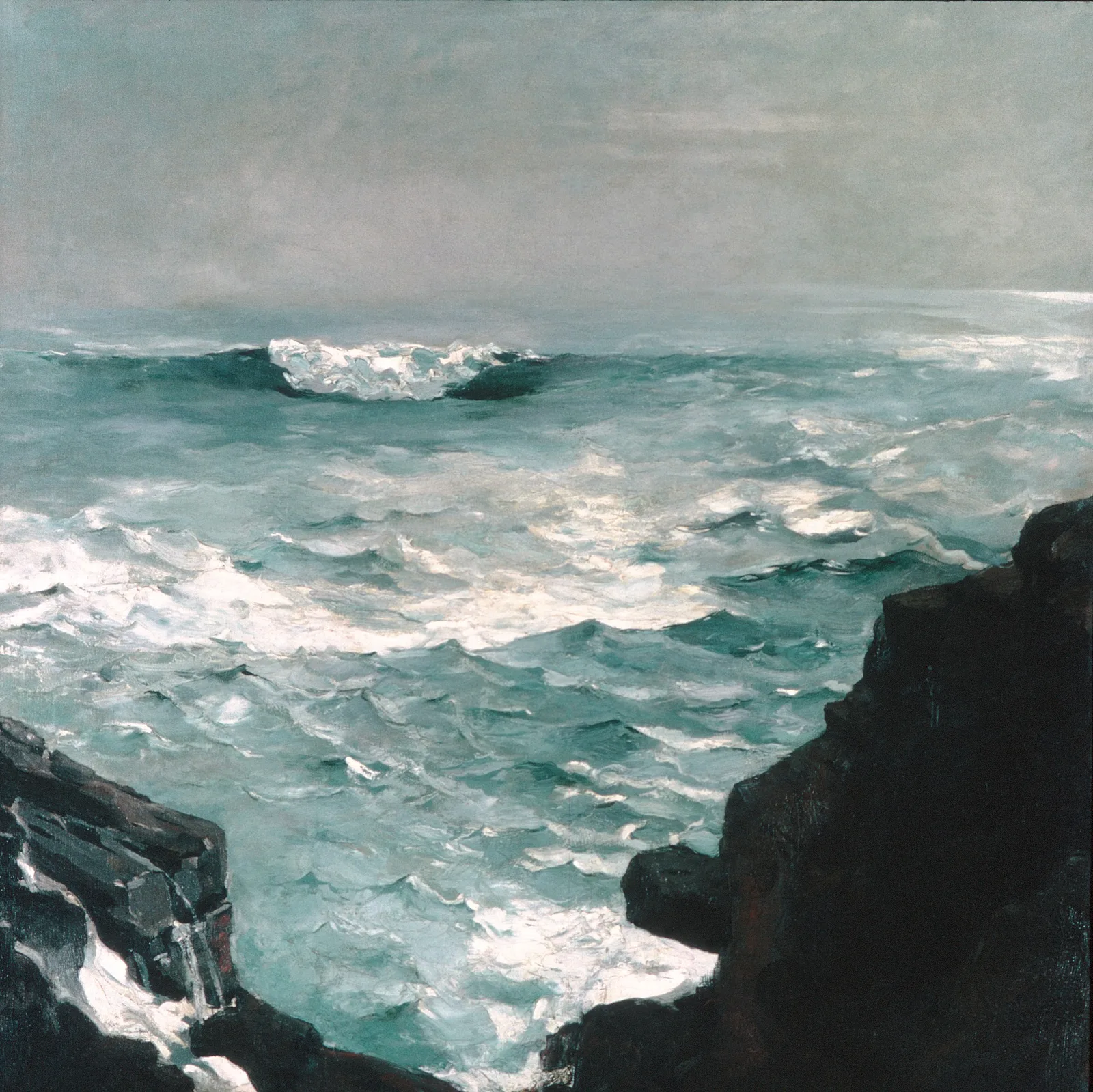
Cannon Rock is a square, 101.6 cm on each side. Here the rock does not carry the whole bottom edge. There is one black mass of rock at lower left and another at lower right, and between them a channel of water narrows toward the bottom of the frame. The viewer's eye is at a height that looks down into the gap between the two rocks.
The horizon sits a little less than a third of the way down, and above it is an almost featureless grey sky. Near the horizon, a little left of centre, a single wave breaks white. The sea below it is broken into short strokes: the strokes in front are large, and they grow smaller and denser as the water recedes. Distance is built not with drawn lines but with the size of the brushstrokes.
When foam is underfoot: Maine Coast
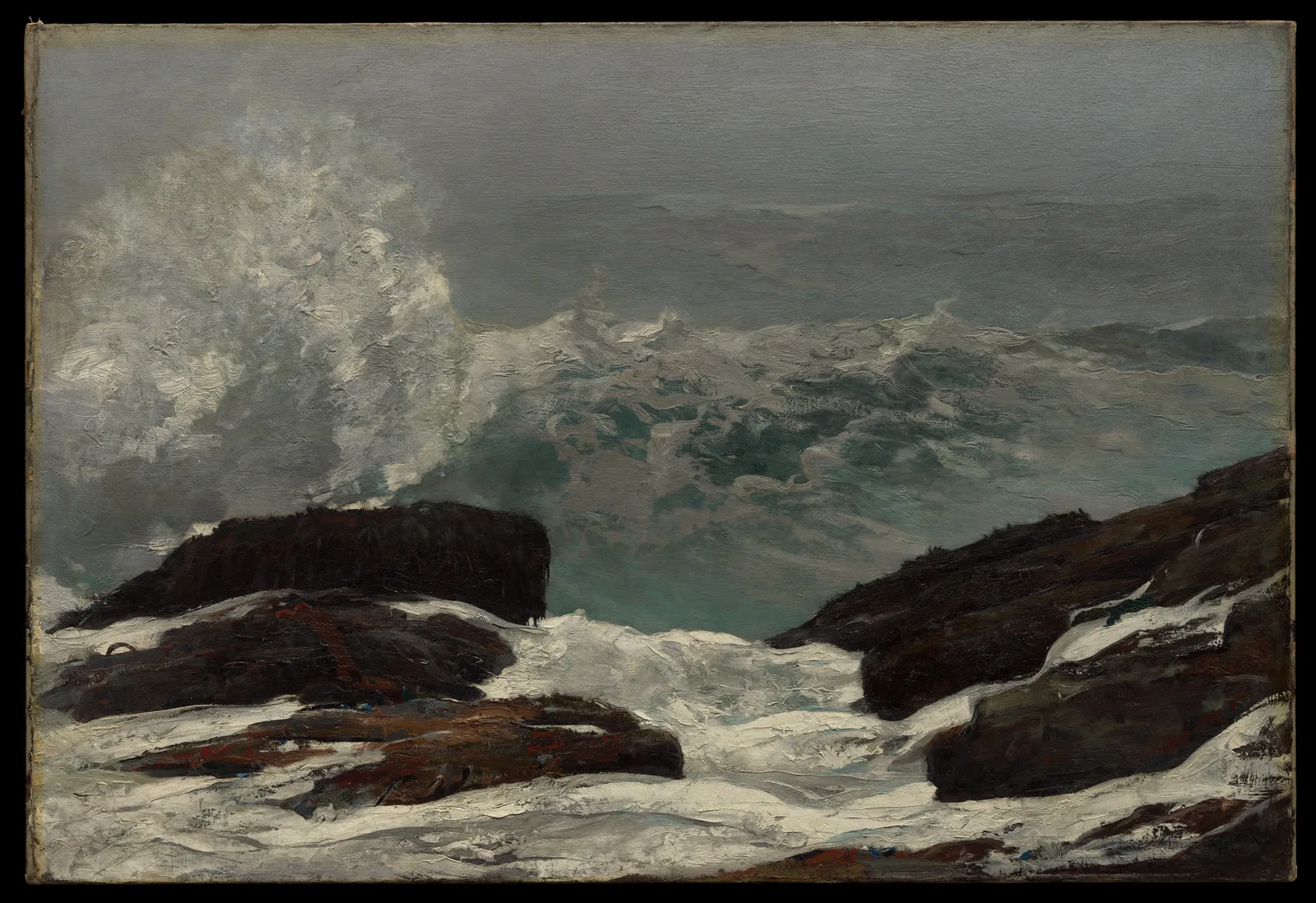
In Maine Coast the rocks stand apart like islands. There are several masses at lower left and at right, but the water between them and most of the bottom edge are covered in white foam. The foam is dragged on in thick white paint, and its surface stands up from the canvas. Unlike the first two pictures, there is no continuous rock surface directly in front of the viewer's feet.
At left the spray rises from behind a rock to well above half the height of the picture. The horizon is the highest of the four, about a quarter of the way down, and faint: sky and far sea are a similar grey, so the boundary almost dissolves. The Met notes that this was one of four ambitious paintings Homer showed at the Paris Exposition, where they were well received.
Rocks at night: Moonlight, Wood Island Light
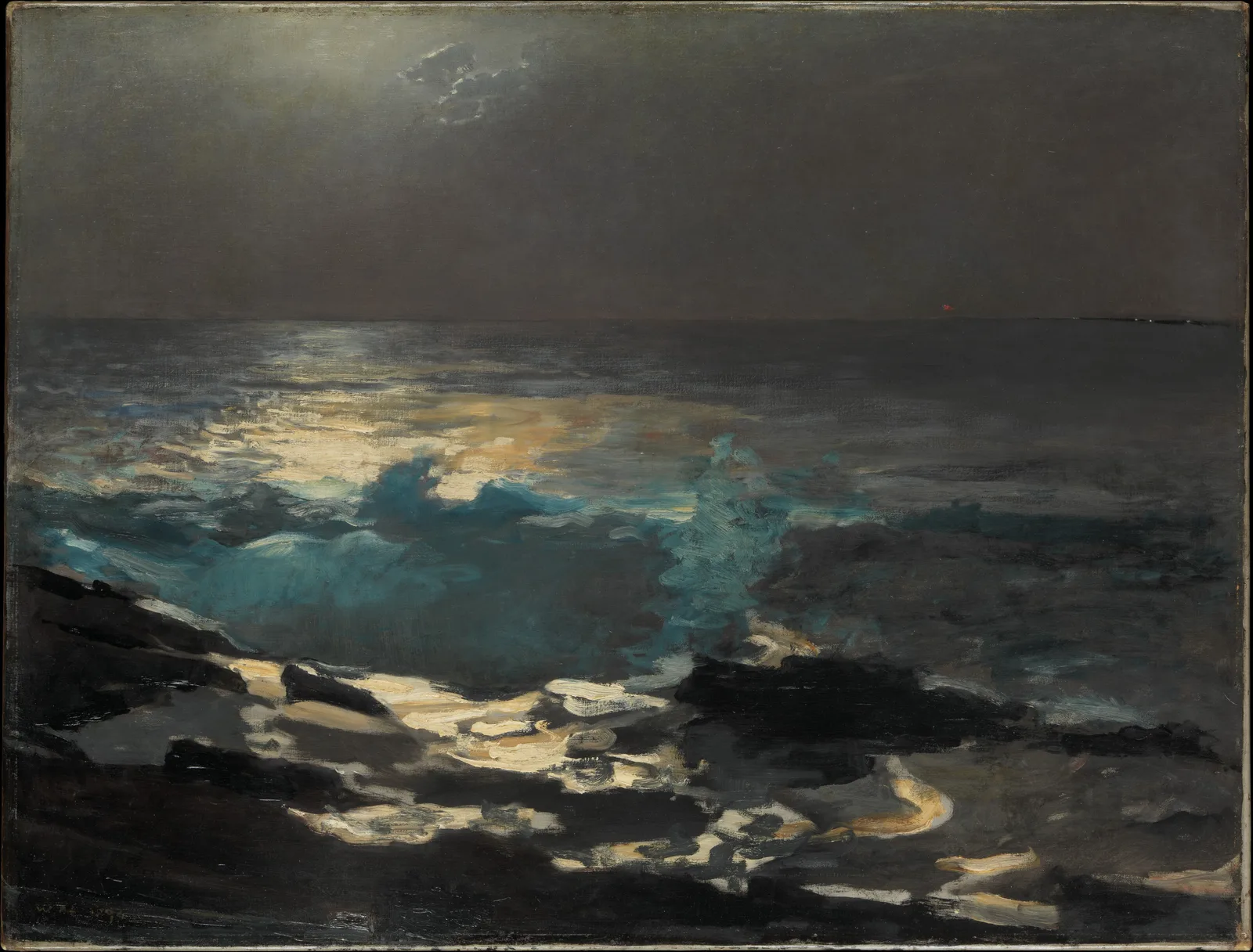
Moonlight, Wood Island Light is a night scene. The moon is hidden behind cloud a little left of centre near the top, and below it a bright path crosses the sea. The horizon runs straight across about a third of the way down, and near its right end sits a single small red point. Since the title names a lighthouse, the point reads as a distant light.
The brightest place is not the sky but the rocks in front. On the black rocks at the bottom, pale yellow and white are laid on in short, thick strokes: the places where moonlight catches wet rock. The Met relays an anecdote from Homer's first biographer: on a summer evening in 1894 Homer took his painting outfit, clambered down over the rocks toward the shore, and this picture was the result of that impulse and four or five hours' work. Of the four paintings, it is the only one with a record that hints at where the painter stood.
A distance from which danger can be watched
Placed side by side, the four pictures put the viewer in slightly different places. Northeaster gives a broad ledge; Cannon Rock sets you between two rocks; Maine Coast fills the ground at your feet with foam; Moonlight puts the light-struck rocks at the very front. And none of them now contains a person.
The eighteenth-century British writer Edmund Burke, in A Philosophical Enquiry into the Origin of Our Ideas of the Sublime and Beautiful, published in the late 1750s, located the sublime in ideas of pain and danger. When danger presses too near, he wrote, it is simply terrible, but "at certain distances" it can be delightful. Homer's ledge does the work of that distance. The spray reaches the top of the frame, but the viewer stands on a solid surface a step behind it.
Seen this way, removing the two figures from Northeaster makes sense. Figures in the picture become the measure of the wave, and the viewer becomes a spectator watching them. Take them away and their place on the rock passes to the viewer. A 1901 review quoted by The Met praised the painting for the strength of the rocks, the weighty movement of the sea and the atmosphere of great natural spaces "unmarked by the presence of puny man."
The Met also notes that these late seascapes had a formative influence on the modernist artists who came to Maine in the early twentieth century. In pictures that drop story and figure and keep only rock, water and air, Homer's late work stands at the far edge of nineteenth-century American realism and at the point where the next generation set out.
In front of the next seascape
Next time you face a seascape, look at the bottom edge before the waves. See whether there is a solid surface there, and if there is, measure with a finger how far it is from the horizon. The distance between the ground at your feet and the horizon is the amount of safety the picture allows you, and it is within that distance that fear turns into delight.
Add your perspective.
Share a question, another approach, or something you have tried.
Checking sign-in…
Loading comments…